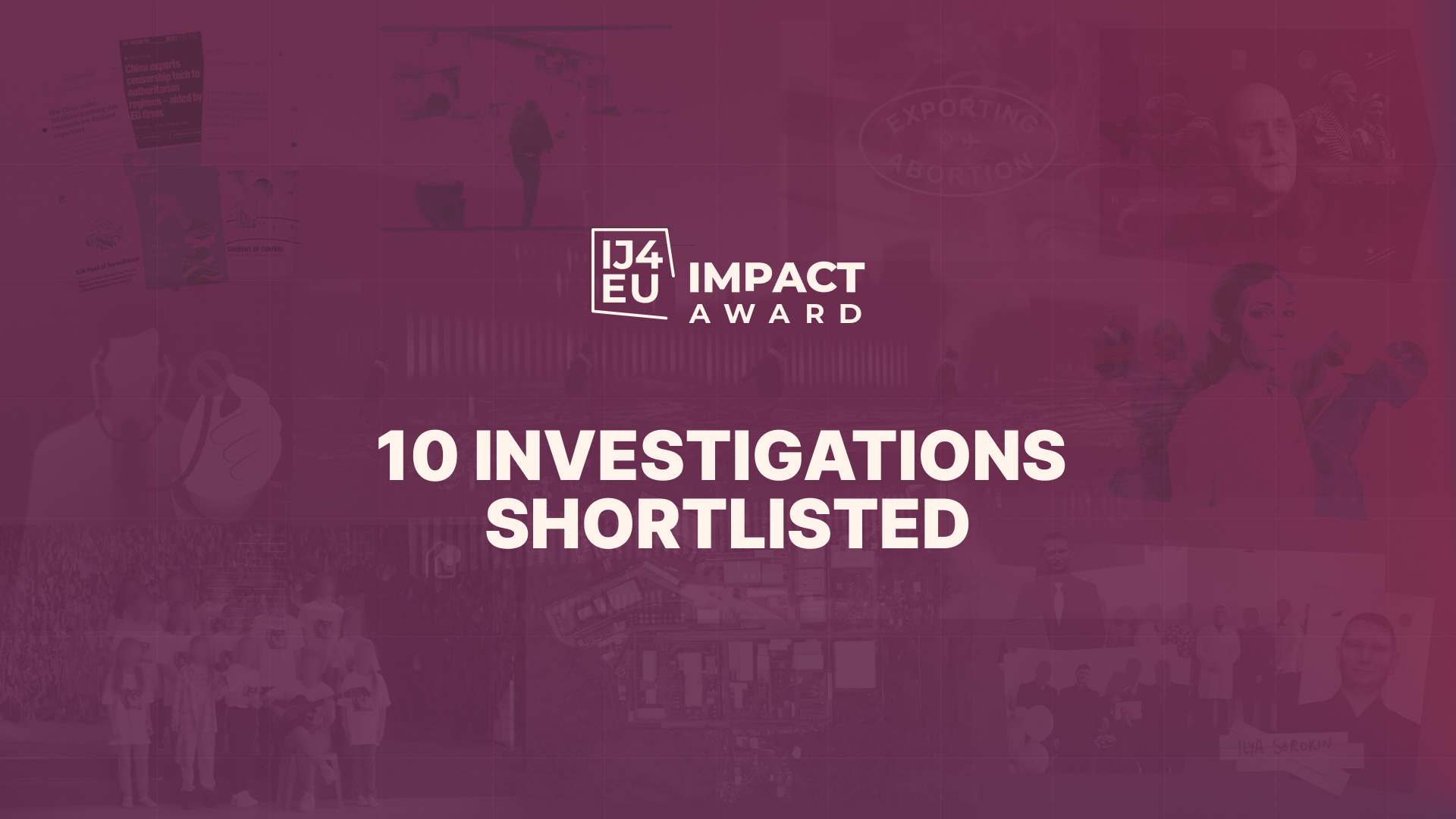


Ten outstanding investigations have been shortlisted for the 2026 IJ4EU Impact Awards, celebrating collaborative journalism that drives real change across borders in Europe.
With a record 50 eligible entries this year, the nominations reflect cross-border collaboration in European watchdog journalism at its strongest yet. The nominated teams comprise nearly 600 journalists from 63 countries, including 26 EU member states, and span a geographical range from Iceland to Uganda.
Independent evaluators at Leipzig University carried out the pre-evaluation process that produced the shortlist. The process was convened by the European Centre for Press and Media Freedom (ECPMF), one of the IJ4EU fund’s core partners.
Three winning teams, each receiving €5,000, will be chosen by an independent jury chaired by Leila Bičakčić, one of Southeast Europe’s leading investigative journalism experts. The jury will consider all eligible nominations in reaching its final decision.
The winners will be announced on September 17, 2026 during IJ4EU’s annual UNCOVERED Conference, hosted in Budapest by Goethe-Institut Hungary.
Take a closer look at the 10 shortlisted investigations, listed in alphabetical order:
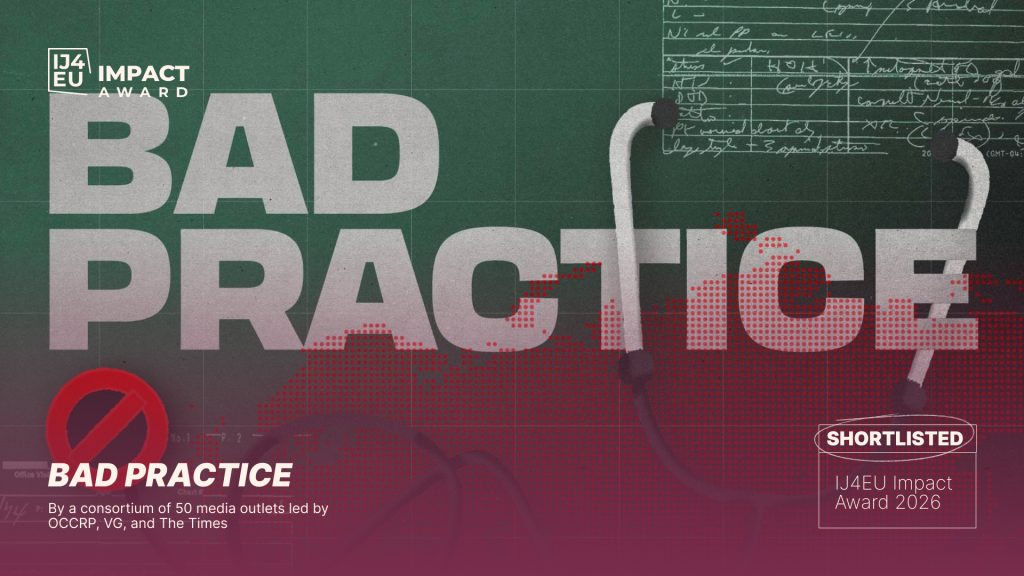
Bad Practice
By a consortium of 50 media outlets led by OCCRP, VG, and The Times
Doctors banned in one country, practising in another
Convicted of sexually abusing patients in France, a cardiologist simply obtained a new licence in Belgium. A surgeon stripped of their licence in Norway for causing irreversible harm to many patients still treats patients in Germany. These are not isolated cases.
This cross-border investigation uncovered more than 100 cases of doctors stripped of their licence in one country continuing to practise in another. At the heart of the problem is the EU alert system, which was built to flag dangerous doctors across borders but is barely used or entirely ignored by many member states.
The true scale is likely far greater, hidden behind a wall of missing and incomparable data across jurisdictions.
The findings gave patients a voice and pushed regulators towards reform, prompting fresh disciplinary action against doctors identified as ongoing risks.
DRC’s European Shadow Army
By Andrei Popoviciu, Ana Poenariu, Emmet Livingstone, and Marine Leduc
“A deadly circus”
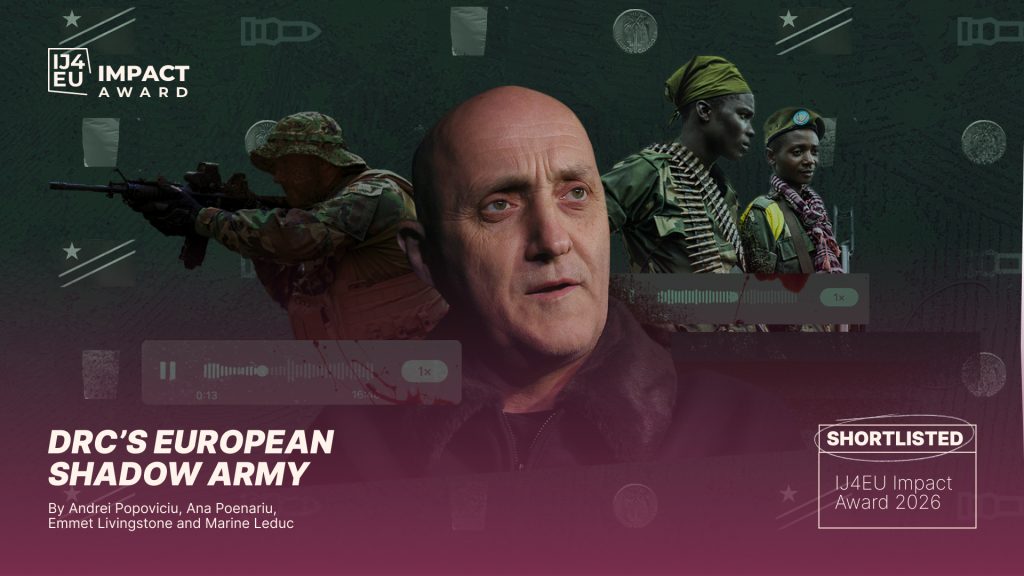
A thousand mercenaries nicknamed “the Romeos” were sent from Romania to defend the eastern Congolese city of Goma from rebels. Most were security guards, truck drivers, and men in their sixties, who had never fired a shot. Led by ex-Legionnaire Horațiu Potra, the mission collapsed into chaos, resulting in the deaths of at least four men.
Officials called them simply “instructors”. This joint investigation by four freelance journalists exposed the truth: the mercenaries fought directly in combat and armed militias linked to war crimes.
Behind the battlefield chaos lay a hidden empire involving $7 million in alleged tax evasion and shell companies across five countries. Most striking of all, Potra had bankrolled a far-right presidential bid in Romania, then allegedly led an armed convoy towards Bucharest when the vote was annulled.
The fallout was immediate: Potra’s arrest, frozen assets, and a new law banning mercenaries from Romania’s armed forces.
Exporting Abortion
By a Europe-wide team led by Público, including The Journal, OKO.press, Expresso, Amphora Media, Page404, and other outlets and freelancers
Denied health care at home
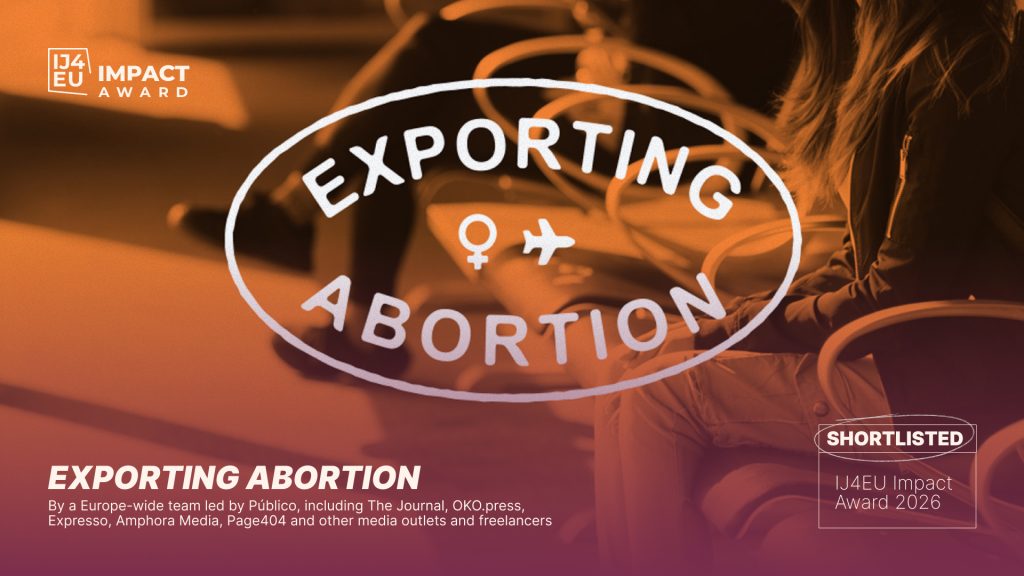
This cross-border investigation led by Público revealed that more than 5,000 women a year travel abroad for abortion care in Europe, mapping previously unquantified routes to countries such as Spain and Slovenia.
At least eight countries don’t even track procedures performed on non-residents, leaving the true scale hidden. In places like Andorra and Malta, abortion isn’t prevented; it’s outsourced, forcing women to shoulder the cost of travel and the burdens of secrecy and delay alone.
By turning scattered national data into one European story, the investigation made a hidden phenomenon visible for the first time, fuelling policy debate on reproductive rights across the continent and reframing how this quiet but urgent issue is understood.
Factories on the run: Inside the global trade that moves PFAS downstream
By Gianluca Liva, Marta Frigerio, Anna Violato, Filippo Tommasoli, Thomas Goorden, and Varrun Sukhraj
The factory that wouldn’t quit

The Miteni factory in Vicenza, Italy, poisoned drinking water for 350,000 Italians for decades, pumping out toxic “forever chemicals” called PFAS, which have been linked to cancer. The company went bankrupt in 2018, and its former executives received a combined 141 years in prison for poisoning the water supply. Justice served, story over. Or so it seemed.
The team of freelance reporters found that production had never truly ended. The factory was sold to an Indian firm, dismantled, and rebuilt in a forest nine hours from Mumbai. Production restarted in 2023: same chemicals, same buyers, same supply chain. The sale was arranged before the company went bankrupt.
Their story ignited political fallout in India. Lawmakers demanded the plant’s closure, protests broke out, and the case reached Parliament, where officials were forced to answer for it.
The Forever Lobbying Project
By a consortium of 29 media partners across 16 countries, coordinated by Le Monde
Europe’s €2 trillion bill for toxic pollution
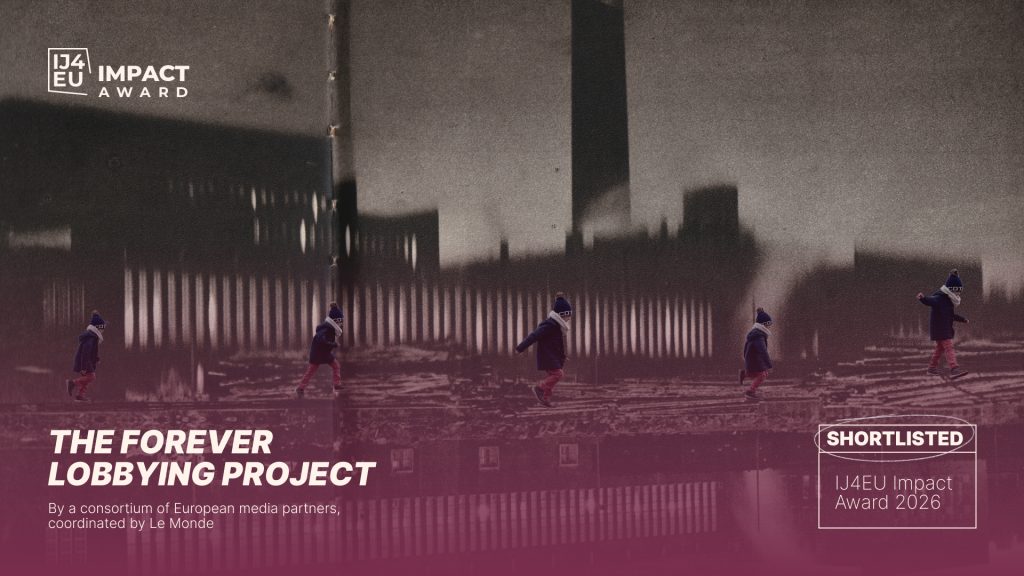
PFAS, or “forever chemicals”, now contaminate drinking water, rain, and the blood of nearly every person on the planet. Scientists call them the greatest chemical threat of the century.
A cross-border investigation by 46 journalists and 18 experts, coordinated by Le Monde, tracked in real time how powerful industries worked to weaken and delay EU legislation restricting PFAS. The investigation also delivers the first estimate of the financial impact of that delay: more than €2 trillion in clean-up costs across Europe over the next 20 years.
By rigorously testing the industry’s key lobbying claims against the evidence, the reporting found many to be misleading, scaremongering, or simply false. The investigation also uncovered an unprecedented trove of more than 14,000 previously unpublished documents through freedom-of-information requests in 16 countries. Together, the documents form the largest archive of PFAS-related records of its kind and are now publicly accessible through university research libraries in the United States.
The Great Firewall Export: China’s Censorship Technology Goes Global
By InterSecLab, Amnesty International, Justice For Myanmar, Paper Trail Media, The Globe and Mail, The Tor Project, Der Standard, and Follow The Money
Chinese surveillance now available at home

Fang Binxing built China’s Great Firewall. Now his company, Geedge Networks, sells it worldwide. A leak of more than 100,000 documents, analysed by eight media partners, revealed that a system that can monitor every user in real time and block VPNs on command has been sold to Kazakhstan, Ethiopia, Pakistan, and Myanmar.
In Myanmar, the junta used it to turn internet providers into surveillance tools after a 2021 coup. In Ethiopia, it helped block social media during protests. The system runs on Western infrastructure, including software from France’s Thales Group and Alibaba Cloud servers in Germany. Job postings show Geedge is eyeing Malaysia, Bahrain, Algeria, and India next.
The findings sparked scrutiny abroad, fuelling calls for sanctions against Geedge and questions about the role of Western firms in enabling it.
In the Russian Penal Colony, They Called Him ‘Dr. Evil’
By Olya Ivleva and Kira Tolstyakova (Schemes, RFE/RL’s Ukrainian Service). Elena Loginova, Julia Wallace, Ilya Lozovsky and James O’Brien (OCCRP)
The name behind the moniker exposed
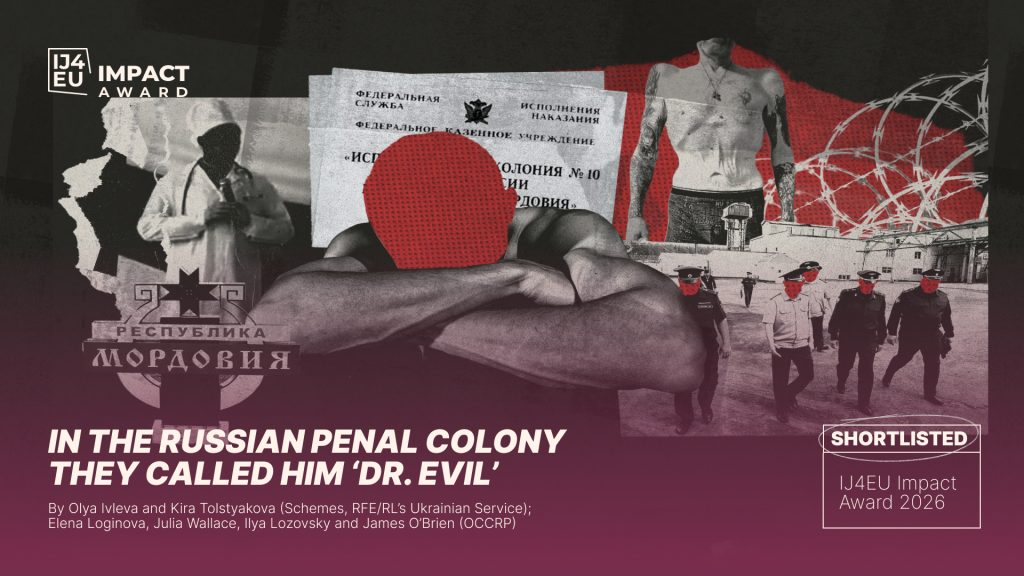
Ukrainian prisoners of war were tormented by a doctor they knew only by a nickname. Reporters set out to discover who he was.
Survivors released in prisoner exchanges since 2022 described a prison doctor at Russia’s Penal Colony No. 10 who administered electric shocks to their hands, withheld treatment as wounds festered, and laughed while a man died.
Schemes, RFE/RL’s Ukrainian investigative unit, and OCCRP identified “Dr. Evil” through open-source analysis as 34-year-old Ilya Sorokin. Online, he appeared as an ordinary professional, posting skits and workplace videos with colleagues — an image sharply at odds with survivor accounts.
The investigation documented one of the clearest cases of war crimes inside Russia’s penal system, gave survivors a public voice and contributed evidence to international war-crimes records. The EU later sanctioned Sorokin for war crimes.
Killing for the Photo: Story behind the only Photographs of an Execution in the Yugoslav Wars
By Barbara Matejčić in collaboration with Natalija Jovanović and Ruben Brugnera, published by BIRN (Serbia) and Novosti (Croatia)
Bosnia’s most notorious war photograph
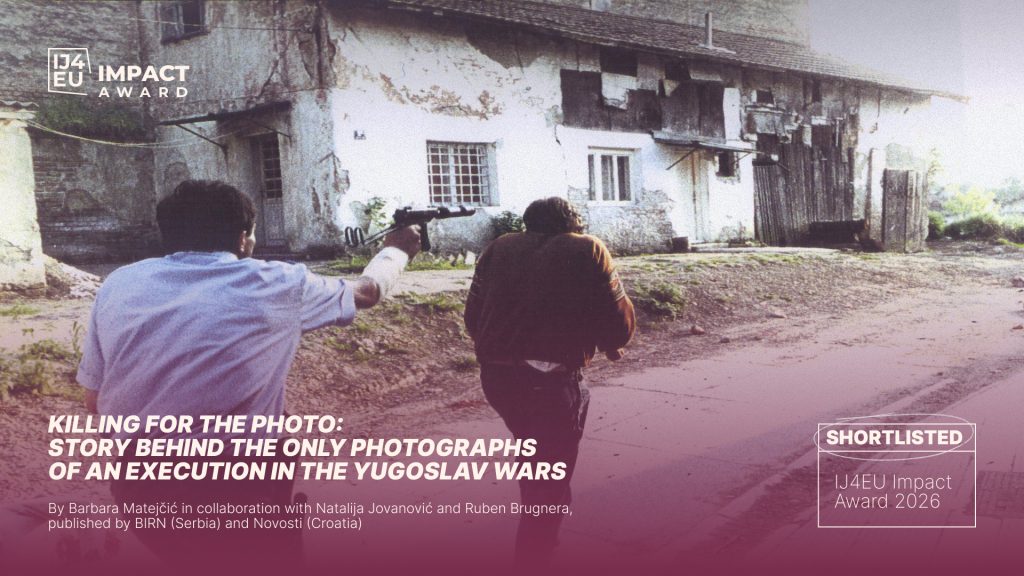
In 1993, a photograph of an execution during the Bosnian War won the World Press Photo Contest and ran worldwide via Reuters. How did a photographer capture a killing at close range, in multiple frames? And why did the killer let him?
The investigation reconstructs the story behind the image, drawing on accounts from nearly 30 sources — including the photographer, the perpetrator, the victim’s family, Reuters editors and members of the 1993 World Press Photo jury — as well as court files and war-crimes records.
The findings raise hard questions about complicity and journalistic ethics. Did the camera’s presence shape the violence? Did the editors and judges ever grapple with that before rewarding the images?
Three decades on, the investigation forces a reckoning with how war photography can cross from documentation into exploitation.
State Children: What Happened to Orphaned Children During the Evacuation to Turkey
By Yanina Korniienko and Anna Babinec ( Slidstvo.Info), Pavla Holcova (Investigace.cz/OCCRP ), Burcu Karakas (Turkey)
Sent to safety. Left to suffer.
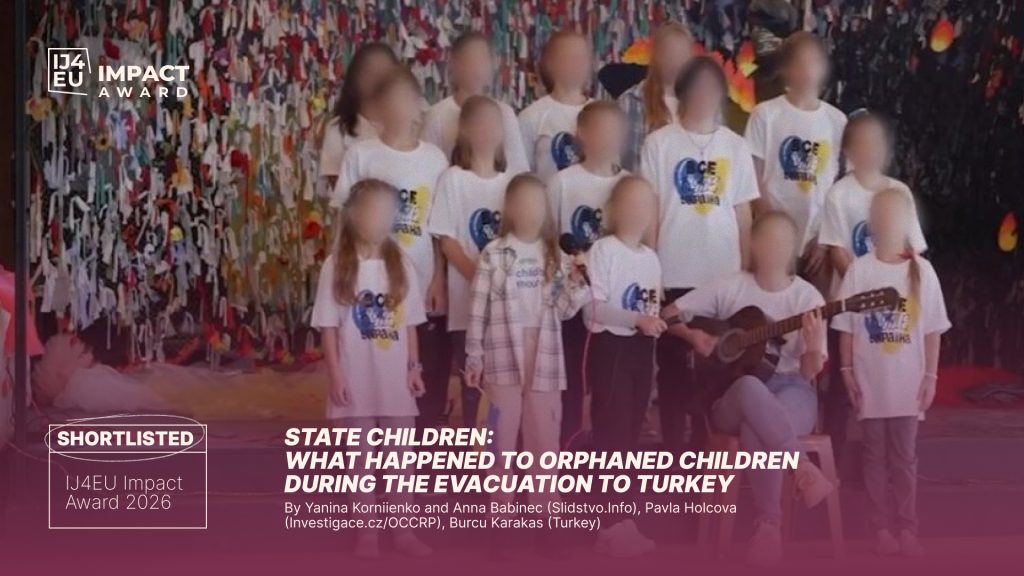
They survived Russian bombs just to be preyed on in a hotel. Thousands of Ukrainian orphans, evacuated to Turkey under a programme called “Children without War”, were placed in the care of officials, organisers, and staff, each assuming someone else was watching. No one was.
Children were filmed for promotional videos, then put to work: cleaning rooms, minding toddlers. Food was rationed. Phones vanished. Education disrupted. Reporters documented beatings and sexual abuse, including two underage girls impregnated by adult hotel staff. Instead of help, they were sent home and told to stay quiet.
A criminal case was opened, then quietly closed. The publication prompted its reopening. Turkey’s Parliament took up the case. Officials in both countries were forced to answer.
The Viktoriia Project
By Forbidden Stories and the Viktoriia Project consortium of 13 media outlets
“Lost in the grey zone”
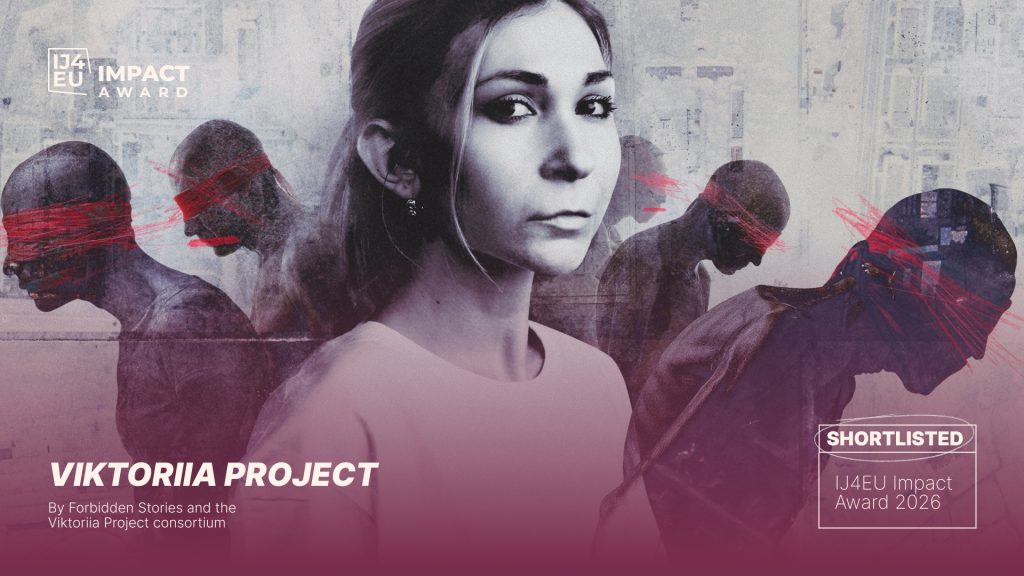
In July 2023, Ukrainian journalist Viktoriia Roshchyna crossed into Russian-occupied Ukraine alone. Days later, she vanished near Melitopol. For months, no news. In 2024, her family learned she was held in Taganrog, a prison known as “Russia’s Guantanamo”. In October 2024, Russian authorities sent a single line: “Viktoriia is dead.” No cause given.
Her disappearance launched an investigation by 45 journalists, who gathered more than 50 testimonies — including accounts from four former Russian prison guards who had defected — and cross-checked them against intelligence and security documents.
The findings expose a hidden system of enforced disappearance and torture against Ukrainian civilians, reconstruct Roshchyna’s final months, and trace how the same tactics were later used by Russian Wagner forces beyond Ukraine.
Viktoriia Project media partners include Der Spiegel, Der Standard, Die Zeit, France 24, Important Stories, Le Monde, Paper Trail Media, RFI, Tamedia, The Guardian, The Washington Post, Ukrainska Pravda, and ZDF.