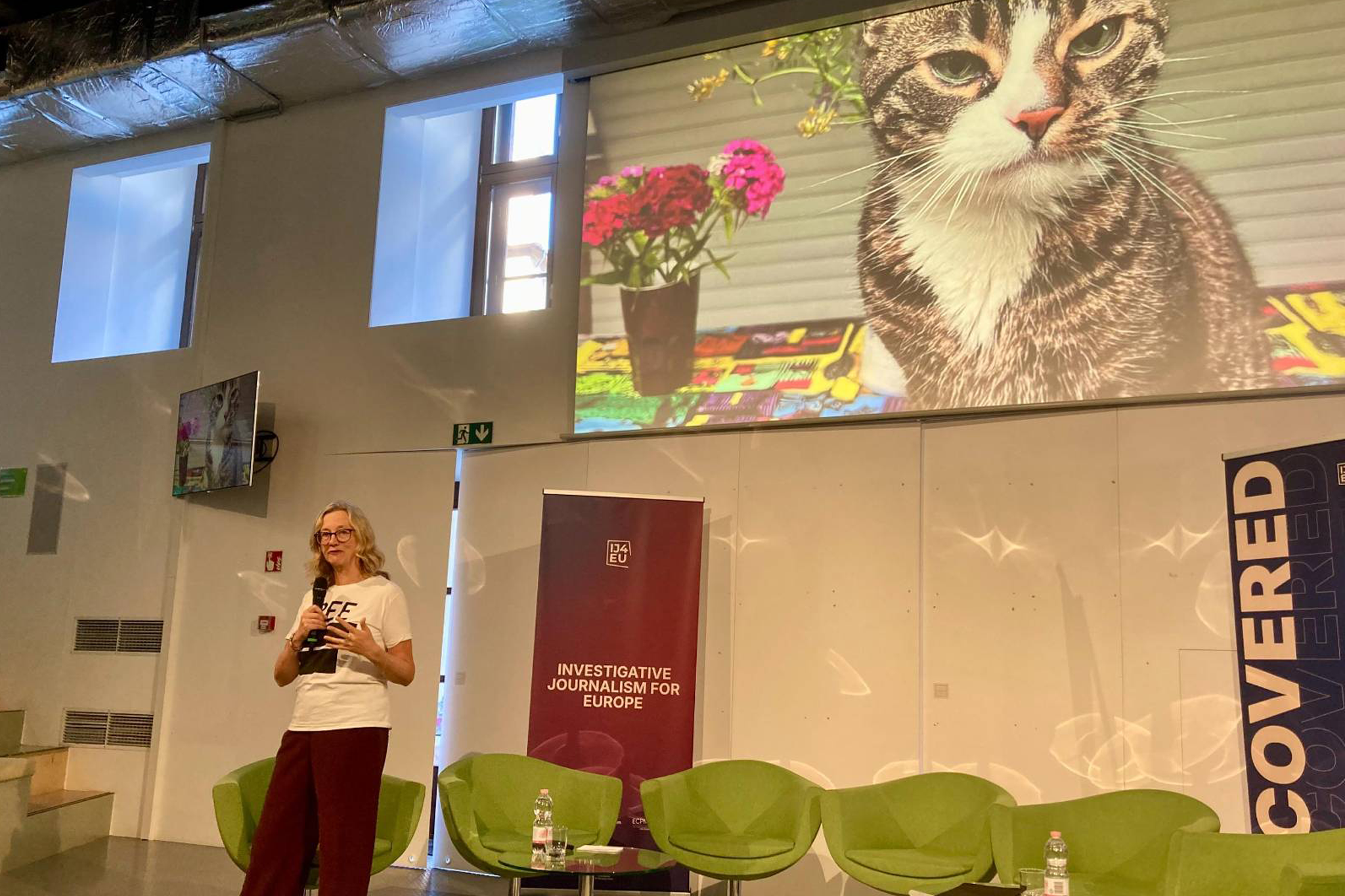


A room full of investigative journalists closed their eyes, took a sheet of A4 paper and followed a set of instructions. Fold it in half. Tear off the upper right corner. Fold it again. Tear off the lower right corner. No questions were allowed.
When they opened their eyes and unfolded the paper, the results were markedly different. Some had intricate patterns. Others were little more than shredded paper.
For Emma Thomasson, who was leading a workshop on communication and conflict at IJ4EU’s UNCOVERED Conference in Budapest, the exercise illustrated a basic problem in collaborative work: giving people the same instructions does not mean they will understand them in the same way.
“The point here is that communication is difficult, and particularly difficult if we are not all from the same background,” said Thomasson, a former Reuters bureau chief who now offers training and consulting on leadership, communication, innovation and workplace wellbeing.
For journalists collaborating across borders, languages, organisations and professional cultures, misunderstandings can arise over everything from deadlines and responsibilities to editorial priorities and who gets the final say.
Conflict, Thomasson argued, is not necessarily evidence that a collaboration has failed. It’s often an inevitable part of getting different people to work together. The challenge is to recognise where friction comes from and tackle it before it becomes personal. Here are some of her tips.
Don’t assume everybody works like you
One risk in collaborative journalism is assuming that shared professional values mean shared ways of working. Teams may agree on the investigation while having different expectations about response times, decision-making, criticism or what it means to have finished a task.
“I think because we assume we’re all part of this same tribe, we make a lot of assumptions that we all work in similar ways that are not necessarily true, and sometimes a lot of this needs to be more spelt out,” Thomasson said.
That makes it important to establish from the start who is responsible for what, how deadlines work, who can make decisions and what happens if the group cannot agree.
Those conversations may need to be repeated when somebody new joins. Drawing on psychologist Bruce W. Tuckman’s model of team development — “forming, storming, norming and performing” — Thomasson noted that periods of friction can arise naturally as people establish roles and test boundaries.
Create room for people not to know
Journalists are professionally accustomed to knowing things — or at least appearing to.
Thomasson recalled editorial calls at Reuters in which reporters demonstrated their command of politics, economics and the news while rarely admitting uncertainty or weakness. That culture can become a problem when team members don’t feel able to say they’ve made a mistake, need help or can’t meet a deadline.
She discussed the importance of psychological safety: whether people feel able to take interpersonal risks without embarrassment or insecurity.
“But you also have to be prepared to take that risk and show a bit of yourself,” she said.
For an investigative team, that openness has practical value. Someone who feels able to admit that they don’t know something or don’t have the capacity to finish a task gives colleagues a chance to address the problem before it becomes a crisis.
Work out which conversation you’re having
A meeting may begin with deadlines and logistics, but that doesn’t mean it remains a practical conversation.
Drawing on Charles Duhigg’s book Supercommunicators, Thomasson distinguished between practical, emotional and social conversations. Problems can arise when participants are effectively talking on different levels.
“So if there’s an emotion in the room, address that first,” she said.
“I mean, we do this automatically, but sometimes when you feel a conversation going off the rails, it’s often because you’re talking on different levels.”
If somebody is angry, frightened or distressed, repeatedly returning to the agenda may not move the conversation forward. Thomasson also encouraged participants to learn more about colleagues beyond their job titles and nationalities, helping them see one another as people rather than simply components of a project.
Check what you’ve actually heard
Journalists spend much of their working lives asking questions. Listening can be harder.
Thomasson recommended repeating the other person’s point in your own words and checking whether you have grasped it.
“Have I understood you correctly?”
That can be particularly useful in multilingual or cross-cultural teams. What one person believes they’ve said and what another believes they’ve heard may be quite different. Checking before reacting can uncover the misunderstanding before an argument develops around it.
Put the problem on the table, not the person
Once a disagreement becomes personal, positions can harden fast.
Drawing on principles associated with Harvard negotiation theory, Thomasson urged participants to separate the person from the problem. Rather than treating a colleague as the obstacle, both sides should approach the disagreement as something they’re trying to solve together.
“And for example, if you’re in a room with somebody, don’t sit opposite the person — sit next to the person,” she said.
Online, a shared document or whiteboard can serve a similar purpose, giving participants something to examine together instead of simply confronting each other through their cameras.
The aim is to move from me against you to us against the problem.
Come prepared to solve the problem
Preparing for a difficult conversation can easily become an exercise in compiling evidence of why the other person is wrong.
Thomasson suggested instead asking everyone involved to think beforehand about acceptable solutions and about fair criteria for choosing between them.
“So even before you come into the room, be solutions-focused rather than thinking of the problem.”
That doesn’t mean abandoning legitimate grievances. It means considering what resolution might look like: the ideal outcome, acceptable alternatives, what the other person may need and what principles both sides could accept.
Give disagreement enough time
Conflict resolution also takes time — something investigative teams often feel they don’t have.
A significant disagreement is unlikely to be solved in the last five minutes of an editorial call. If the relationship matters, Thomasson’s advice was to set aside enough time for both sides to explain how they see the problem, establish what is actually disputed and consider ways forward.
Conflict becomes harder to resolve when the person on the other side is reduced in your mind to an obstacle, stereotype or set of bad intentions, she added.
Thomasson encouraged participants to consider how the other person might understand the situation, what pressures they face, how they would describe their own intentions — and how they might describe yours.
“Instead of focusing on what’s going wrong, you need to focus your energy on helping things go right.”
An obvious tension exists for investigative journalists, whose professional instinct is to identify wrongdoing, scrutinise responsibility and examine what has gone wrong. That critical mindset is essential to their reporting. It may be less useful when applied automatically to colleagues.
The lesson is not to avoid conflict or force agreement, but to become better at handling disagreement: clarify expectations, check what you have heard, recognise emotions, separate people from problems and enter difficult conversations thinking about solutions, Thomasson said.
For investigative teams, that can matter beyond workplace harmony. The relationships holding a collaboration together can ultimately help determine whether the journalism gets done at all.
Visit the UNCOVERED 2026 microsite for more information about the conference.