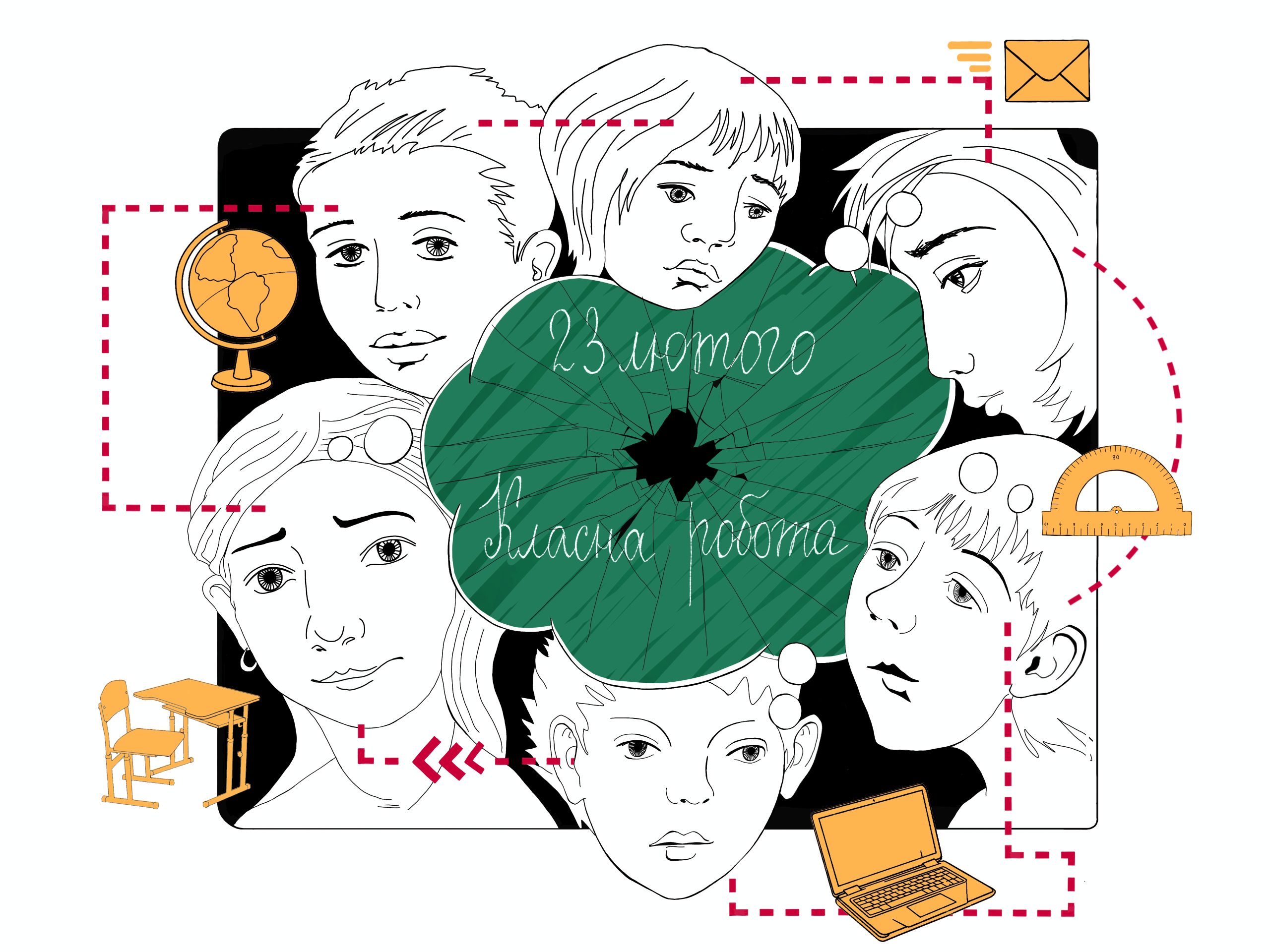


Two journalists in Ukraine and Poland investigate how the full-scale Russian invasion has upended Ukrainian schooling, reshaped childhood and placed profound psychological and academic pressures on young Ukrainians — both at home and abroad.
The Russian invasion delivered a devastating shock to Ukraine’s education system. The investigation maps the scale of disruption, revealing how children at every stage of schooling have been affected.
Around half a million pupils have dropped out of frontline regions — including Kharkiv, Donetsk, Luhansk, Zaporizhzhia and Kherson — moving elsewhere in Ukraine or leaving the country entirely.
Repeated attacks on civilian infrastructure have damaged or destroyed more than 1,622 school buildings — roughly one in seven — with over 200 wiped out completely. Millions have been forced out of physical classrooms. For many, the only remaining option is remote or hybrid learning. About one million children — nearly 30 percent — have had only intermittent access to schooling in recent years.
Journalists followed a class from Kharkiv over nearly two years to document what it means to study online as a war grinds on. For these children, distance learning can mean logging into class during air-raid alarms, working without stable electricity or a reliable internet connection, or trying to keep up after displacement. Online learning is a lifeline — but a fragile one.
The investigation also tracked a group of Ukrainian schoolchildren now living in Poland, revealing the psychological strain and adaptation challenges they face. Many families hesitate to enrol their children in local schools, clinging to the hope of returning home. Language barriers, placement hurdles, the need for additional classes, and fears of “losing a year” all contribute to low enrolment.
Across the EU, the true number of Ukrainian children outside host-country school systems remains unclear. According to UNHCR, around 600,000 of the 1.4 million Ukrainian children abroad are not attending local schools. Some may continue studying online in the Ukrainian system; others may not be studying at all. The highest proportions of Ukrainian pupils outside both systems are found in Moldova (65%), Bulgaria (23%), Slovakia (13%), Romania (12%) and Poland (11%).
The investigation warns that the risks of deepening educational inequality — and of a potential “lost generation” — are significant. Prolonged disruption could widen learning gaps and create lasting setbacks in academic progress, social development and future opportunities.
The consequences go far beyond missed lessons. Children are carrying trauma, instability, isolation from peers and the loss of the social-emotional support that schools normally provide. The long-term psychosocial impact is enormous — with implications not only for individual wellbeing but for Ukraine’s future human capital.