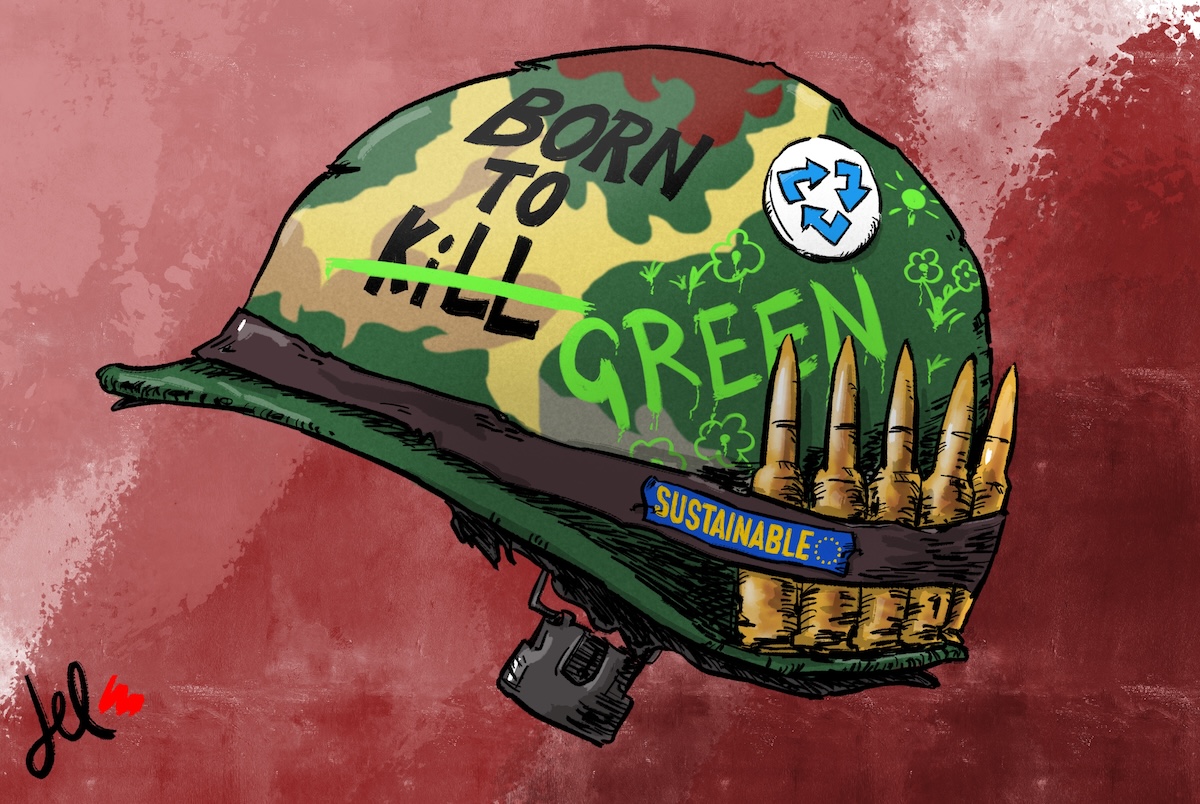


This cross-border investigation, coordinated by Voxeurop in partnership with El País (Spain), IrpiMedia (Italy) and Mediapart (France), examines the rapid growth of so-called sustainable investments in Europe’s defence industry and the regulatory and policy dynamics behind it.
The investigation found that ESG-labelled investments in 118 large, publicly listed defence companies more than tripled between 2021 and the first quarter of 2025, rising from €14.5 billion to €49.8 billion. This increase coincided with a gradual broadening of how “sustainability” is defined within parts of the European sustainable finance framework, including arguments advanced by defence industry actors that link security and sustainability.
Drawing on data from the London Stock Exchange Group (LSEG), documents obtained through Freedom of Information requests, and interviews conducted between 2021 and 2025, the investigation traces how defence-related activities came to be included in investment funds marketed as “ESG” or “transition.” It examines the role of ratings methodologies, industry lobbying, policy reports and stakeholder meetings in shaping this shift.
In the first quarter of this year alone, 104 companies received nearly €50 billion in “sustainable” investments marketed by major asset managers authorised to operate in European markets. Half of this amount went to 27 European companies, including France’s Safran (€5.6 billion) and Germany’s Rheinmetall (€4 billion), as well as MTU Aero Engines, Leonardo, Thales, Indra, Saab, Rolls-Royce and BAE Systems.
Among the beneficiaries is Israel’s largest arms manufacturer, Elbit Systems — the Israeli army’s main supplier — which appears in funds labelled “ESG” or “transition”. Most of the European firms cited are members of the AeroSpace and Defence Industries Association of Europe, which has actively lobbied — through meetings and policy reports — for defence companies to be included in sustainable investment funds.
Major events have been organised to bring together the arms industry and the financial sector, with the aim of persuading asset managers of a central claim: that the EU’s green finance regulatory framework is “sector-neutral”.
The only explicit reference to military activity in the list of “principal adverse impacts” used to assess harm concerns so-called controversial weapons — anti-personnel mines, cluster munitions, and chemical or biological weapons. In practice, the financing of tanks, armed drones, ammunition, firearms — and even nuclear weapons — is not explicitly excluded as causing “significant harm.” As a result, funds marketed as “climate transition” or “ESG” may include arms manufacturers.
The investigation also shows that critical voices within the financial sector have been marginalised in this debate.
The project highlights the political role of the European Commission in the gradual inclusion of defence activities within the scope of green and sustainable finance, in close alignment with the defence industry — going so far as to adopt its framing.
Over the past year, the slogan “There is no sustainability without security” has become commonplace in policy discussions.
When questioned, a spokesperson for the Commission’s financial services department said “the EU’s sustainable finance framework does not pose any obstacle to private investment in the defence sector”, with the exception of controversial weapons.
“In truth, there can be no sustainability without peace,” UN expert Attiya Warris said. “Security does not necessarily mean the manufacture and use of weapons, which can lead to unlawful killings. Financing and enabling such killings by providing weapons and financial support throughout the value chain does not fit our definition of security.”
In March 2026, the investigation won the Voices Award 2026 in the Press, Video and Documentary Journalism category.
Team:
Voxeurop: Giorgio Michalopoulos, project coordinator; Gian-Paolo Accardo, editor; Stefano Valentino, reporter
IrpiMedia: Carlotta Indiano, reporter; Giulio Rubino, editor; Fabio Papetti, reporter
Mediapart: Yann Philippin, reporter
El Pais: Daniele Grasso
Freelance: Futura D’Aprile