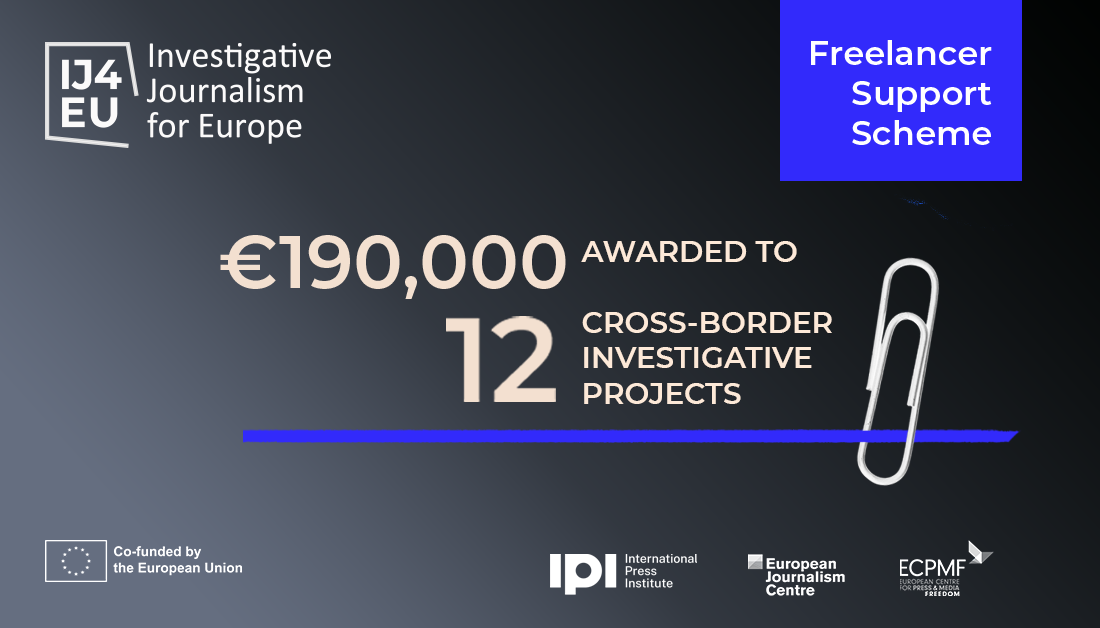


The Investigative Journalism for Europe (IJ4EU) fund has awarded €190,000 to 12 teams of freelance journalists to pursue cross-border investigations across Europe and beyond.
The grants, awarded by an independent jury under IJ4EU’s Freelancer Support Scheme, will support projects chosen from a pool of 117 applications submitted under the first call of IJ4EU’s 2026/27 funding cycle.
The successful teams bring together 41 journalists based in 19 countries.
The scheme supports teams composed mainly of freelancers who collaborate on investigations into matters of public interest. In addition to funding, recipients receive mentoring, training, and networking support.
Their investigations span topics ranging from looted cultural treasures and illegal international adoptions to esports match-fixing, AI-driven labour exploitation, and conflict-linked gold supply chains. The selected projects reflect the diversity of challenges facing Europe today, including threats to democracy, environmental accountability, labour rights, organised crime, and disinformation.
Managed by the European Journalism Centre, the Freelancer Support Scheme runs in parallel to IJ4EU’s Investigation Support Scheme, which awarded €610,000 in grants in the latest funding round.
The selected projects
Here are summaries of the successful projects and the awarded amounts, listed in no particular order:
- A cross-border team will investigate how archaeology has been instrumentalised in Crimea since Russia’s 2014 annexation, including state-led excavations, damage to cultural heritage and the use of archaeological narratives to legitimise occupation. Grant awarded: €11,250
- A cross-border team of freelance journalists from Hungary, France, Germany, and Cambodia will investigate the looting of Khmer temples and the role of European museums and private collectors in the illicit trade in stolen artefacts. – €20,000
- A cross-border investigative team of three freelance journalists will examine biofuel fraud and the opaque supply chains behind Europe’s green fuels. – €7,799
- A cross-border team of three freelance journalists will investigate the precarious conditions and low wages faced by predominantly female workers in Southeast Europe’s automotive supply industry. – €5,675
- A cross-border investigation will examine how authorities in northern Italy, Belgium, and the Netherlands are failing to tackle the nitrogen crisis as livestock farms expand and communities and ecosystems suffer severe pollution. – €12,100
- A cross-border investigative team will map cases of illegal adoptions from Colombia to Europe, identifying those responsible and giving voice to adoptees and families affected by a decades-long practice that has received little attention from authorities or the media. – €17,000
- A cross-border team will investigate the transnational funding and political influence of an ultra-conservative religious network across five European countries, tracing opaque financing used to lobby against reproductive and LGBTQIA+ rights. – €16,735
- A cross-border investigation will examine the role of organised crime in European online betting and digital sports. – €20,000
- A soon-to-launch Mediterranean collective of investigative journalists will coordinate a cross-border project examining abuses linked to the rapid expansion of AI infrastructure. – €20,000
- A new chapter of the award-nominated Scrap Wars investigation will examine metal scrap flows from Gaza, building on previous reporting into scrap exports from war-torn countries. – €19,800
- A cross-border team of journalists based in Italy, Spain, Belgium, and Sudan will investigate how gold linked to conflict zones reaches European weapons markets. – €20,000
- A cross-border team will investigate how a TikTok-based propaganda and disinformation scheme linked to the cancellation of Romania’s 2024 presidential election was exported to Bulgaria, and how actors behind the Romanian operation were able to shift activities to a third EU country without apparent law-enforcement intervention. – €19,950
The next call for applications under both the Freelancer Support Scheme and the Investigation Support Scheme opens on December 1, 2026.
Interested in learning more about projects previously funded by IJ4EU? Check out the projects section on the IJ4EU site.