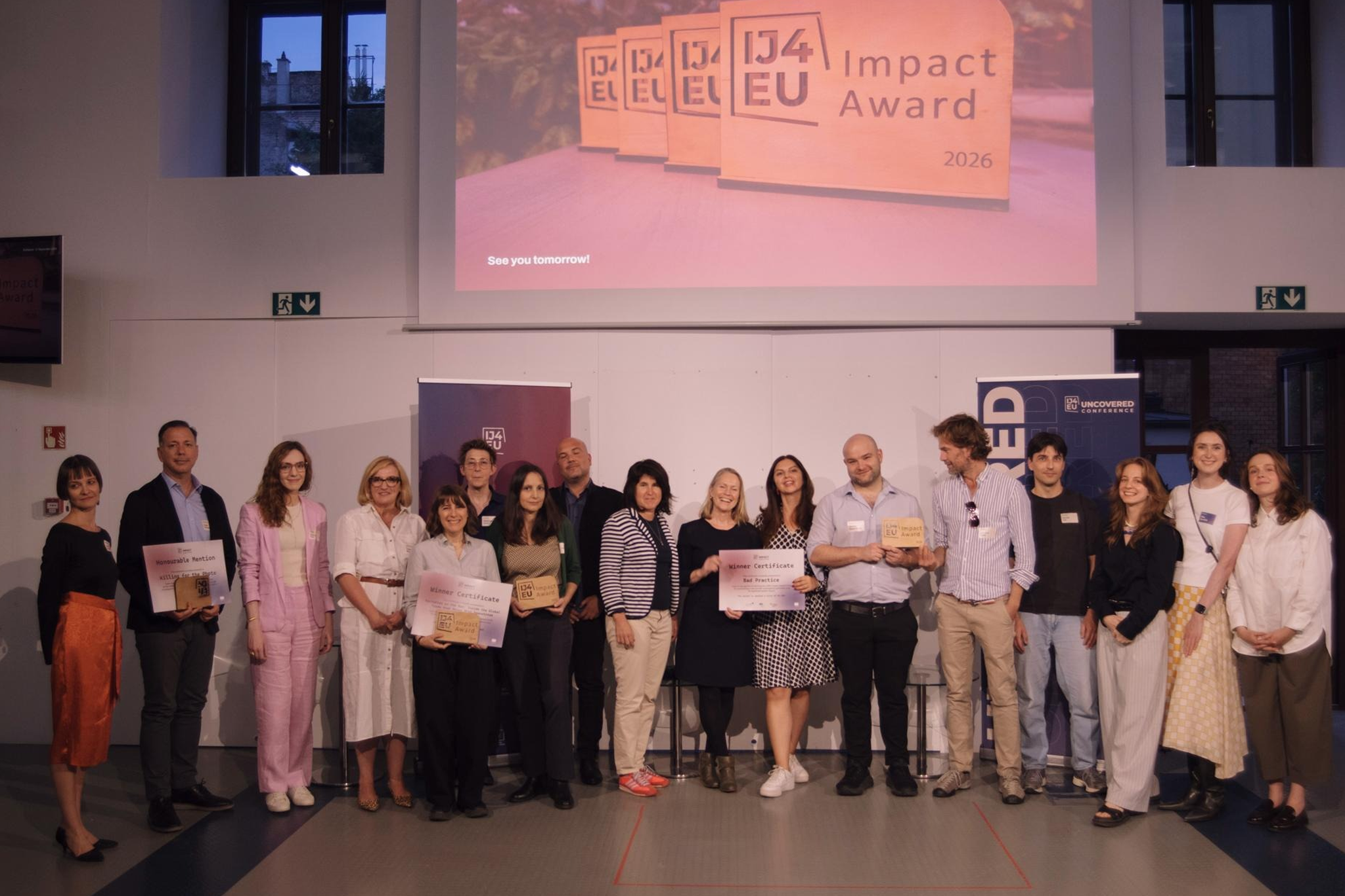


Two investigations into deadly “forever chemicals” are among the three winners of the 2026 IJ4EU Impact Awards, alongside a cross-border exposé showing how doctors sanctioned for malpractice are able to continue working after being banned elsewhere.
The winning teams of journalists each received €5,000 at the annual awards presented by the Investigative Journalism for Europe (IJ4EU) fund, which supports cross-border public-interest journalism in Europe.
In alphabetical order, the three equal winners are:
- Bad Practice, by a consortium of 50 media outlets led by OCCRP, VG and The Times.
- Factories on the Run: Inside the Global Trade that Moves PFAS Downstream, by Gianluca Liva, Marta Frigerio, Anna Violato, Filippo Tommasoli, Thomas Goorden and Varrun Sukhraj.
- The Forever Lobbying Project, by a consortium of European media partners coordinated by Le Monde.
The jury also singled out Killing for the Photo, by Barbara Matejčić in collaboration with Natalija Jovanović and Ruben Brugnera, for special recognition.
The winners were announced on September 17 in Budapest at IJ4EU’s annual UNCOVERED Conference, hosted this year by Goethe-Institut Hungary.
“These are very different investigations, yet they have something fundamental in common,” Leila Bičakčić, chair of the independent jury that awarded the prizes, said at the award ceremony.
“The stories themselves cross borders because the problems they investigate cross borders. Money crosses borders. Pollution crosses borders. Companies cross borders. People cross borders. Political influence crosses borders.
“Accountability therefore has to cross borders as well. And journalism must be able to do the same. That, for me, is one of the strongest messages emerging from this year’s awards.”
Bičakčić, co-founder and executive director of the Center for Investigative Reporting, added: “At a time when investigative journalism faces financial pressure, political pressure, legal threats and declining trust, these projects demonstrate why collaboration is not simply desirable — it is increasingly essential.”
The Impact Award, now in its sixth year, is open to teams carrying out cross-border watchdog journalism, whether or not their work has received IJ4EU funding. Two of this year’s winning projects — The Forever Lobbying Project and Factories on the Run — received an IJ4EU grant.
The jury chose the winners from a record number of entries submitted by journalists in more than 60 countries.
The Impact Award is run by the European Centre for Press and Media Freedom in cooperation with fellow IJ4EU partners the International Press Institute and the European Journalism Centre. IJ4EU is co-financed by the European Commission and supporters including Adessium Foundation, Fritt Ord and the Free State of Saxony.
Bad doctors without borders
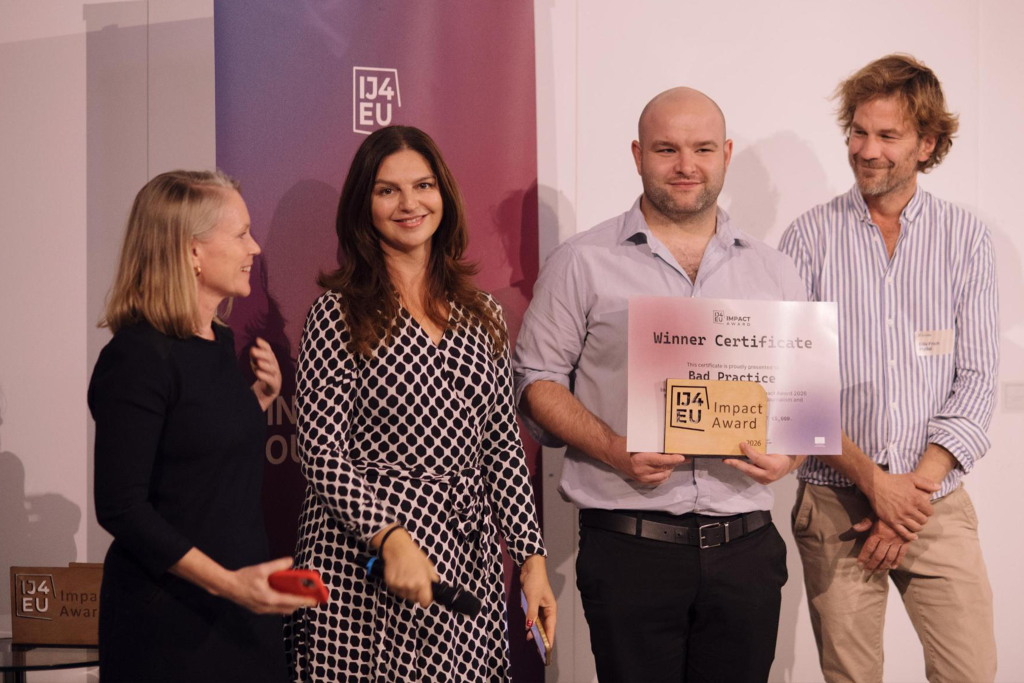
Bad Practice brought together reporters across 44 countries to investigate what happens when doctors are banned from practising.
The unprecedented project identified more than 100 cases in which doctors stripped of their licences for reasons including sexual abuse and reckless malpractice were able to resume practising in another country.
The reporting also examined alert systems intended to warn authorities about sanctioned doctors, finding cases in which warnings either failed to be issued or were ignored.
The jury described Bad Practice as the kind of cross-border collaboration the Impact Awards were created to recognise, citing its scale, ambition and public-interest value.
Jury member Oleg Khomenok, a senior programme manager at Internews Network, noted that the structure of the investigation reflected the problem it exposed, with dozens of country-specific stories published at the same time to reveal a broader, continent-wide failure.
The investigation prompted responses from health ministries and calls for reform from medical associations. The European Commission also agreed to review the alert system highlighted by the reporting.
“This is a multilayered investigation into an issue that puts the safety of ordinary citizens first and can affect any one of us,” Khomenok said.
“It goes far beyond standard reporting by exposing systemic failures in a way that has already forced health authorities to react and begin changing policies. The vast scale and ambition of this project show exactly what cross-border journalism can achieve when it focuses on the public good.”
PFAS factory moves from Italy to India
Factories on the Run traced what happened to the Miteni factory in the northern Italian city of Vicenza, which had contaminated drinking water in the region with PFAS chemicals.
PFAS are a family of synthetic chemicals used in products ranging from non-stick cookware to waterproof clothing. Known as “forever chemicals”, they are highly persistent in the environment and have been linked to serious health risks.
Former executives of the company were eventually sentenced to a combined 141 years in prison.
But a six-person team of freelance journalists found that the factory itself had been dismantled, shipped to India and rebuilt, with production restarting in 2023 using the same toxic chemistry for the same buyers.
The jury praised the investigation for turning an abstract issue into concrete evidence, showing how hazardous industrial activity shut down in Europe could be moved elsewhere rather than disappear.
The reporters traced the machinery from Italy to an enormous industrial enclave in western India, documenting how environmental risks rejected in Europe could be transferred to the Global South.
The findings were later cited in environmental and public-health research.
The investigation also prompted a backlash in India, where lawmakers demanded that the plant be closed, residents protested outside its gates and a petition was launched against the import of banned chemicals.
Juror Neus Vidal, executive director of the Seek Initiative, highlighted the fact that six freelance journalists had produced reporting with consequences spanning two continents and reaching a national parliament.
“What stood out was how much a small team achieved across borders,” Vidal said. “A small group of freelance journalists followed this story from Italy to India, and this is what we mean when we talk about impact: the publication showed the harm that was done, but it also changed the conversation in the place where the harm was happening. Not many investigations, let alone ones this size, can point to that kind of reaction.”
Lobbying over ‘forever chemicals’
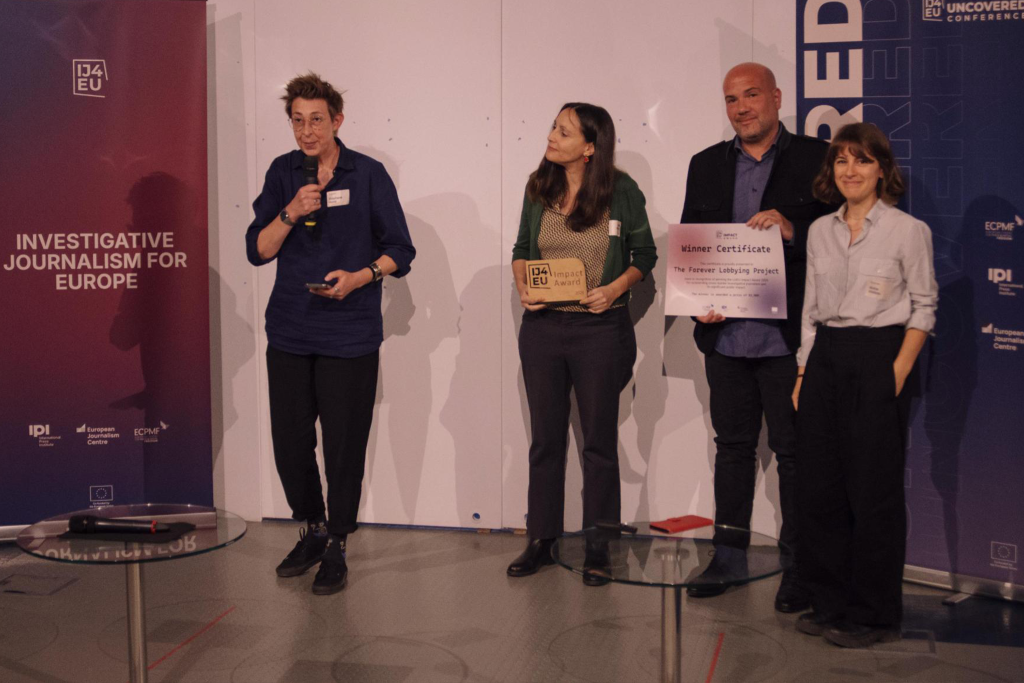
PFAS also featured in The Forever Lobbying Project, a collaboration involving 29 media partners across 16 countries and coordinated by Le Monde.
A team of 46 journalists and 18 experts investigated how industry sought to weaken and delay EU legislation intended to restrict PFAS.
The project calculated that cleaning up PFAS contamination could cost Europe more than €2 trillion over the next two decades.
Reporters tested industry claims against scientific evidence and obtained 14,000 previously unpublished documents through freedom of information requests across 16 countries, creating the largest public archive of its kind.
The jury said the project’s strength lay in going beyond contamination itself to examine the financial and political interests behind it.
Maryna Rakhlei, a senior programme officer at the German Marshall Fund of the United States, highlighted a further theme in the reporting: that the industry’s business model was not only about producing hazardous materials but also about working to prevent or delay regulation.
“What impressed me was that the journalists did not stop at exposing the lobbying,” Rakhlei said. “They asked whether the arguments being used to influence European policy were actually true, and built a rigorous way of testing them with scientists and other experts.
“That is journalism doing more than revealing what happens behind closed doors: it gives the public the evidence to judge whose interests are shaping decisions that affect all of us.”
Jury members also pointed to the scale of the collaboration and the pressure involved in investigating powerful financial interests while facing threats and intimidation.
They described the project as an example of journalism carrying out its public-interest role by exposing conflicts between commercial interests and those of ordinary people.
Special recognition for Yugoslav war investigation
The jury gave special recognition to Killing for the Photo by Barbara Matejčić in collaboration with Natalija Jovanović and Ruben Brugnera.
Published by the Balkan Investigative Reporting Network in Serbia and Novosti weekly magazine in Croatia, the investigation revisited photographs showing a Bosnian Serb paramilitary executing a civilian in Brčko in 1992.
It examined whether the photojournalists who recorded the killing were simply witnesses or whether their presence played a role in what happened.
The photojournalist, who later won a World Press Photo award and received asylum in the Netherlands, came to be regarded as a journalistic hero.
But the caption accompanying the winning image wrongly identified the murdered civilian as an armed sniper and remained uncorrected for 30 years. The investigation led to the caption being corrected.
The jury described Killing for the Photo as one of the most uncomfortable investigations it reviewed this year because of the questions it raised about journalism’s own possible shortcomings — questions that remain highly relevant to how journalists are documenting the current wars in Ukraine and Gaza.
They also highlighted the project’s persistence in returning to events decades later and seeking accountability.
Can Ertuna, a journalist and associate professor in the Faculty of Communications at Bahçeşehir University in Istanbul, said that persistence showed how journalism could contribute to justice and, potentially, some measure of healing for victims and their families.
“This investigation also exposes the gaps that even organisations regarded as standard-setters in journalism may have in verifying information and news, underscoring once again the importance of applying universal journalistic principles regardless of location or context,” Ertuna said.