

Back for a sixth edition, the Investigative Journalism for Europe fund continues its mission to support watchdog reporting.
The Investigative Journalism for Europe (IJ4EU) programme is back for another funding cycle, reopening one of Europe’s most trusted sources of support for ambitious collaborative reporting.
Over the next two years, IJ4EU will commit €1.6 million in grants to investigative teams working across borders, alongside a comprehensive package of assistance that includes:
- Training, mentoring and peer-to-peer learning;
- Tools designed for secure cross-border collaboration;
- Legal aid and security training to help manage real-world risks;
- Awards, conferences and networking opportunities.
The first call for applications opens on February 12, 2026.
Reporting as a public good
Now in its sixth edition, IJ4EU doubles down on its mission to support investigative reporting as a public good — especially the kind of resource-intensive journalism that is hardest to sustain.
International teams of journalists can apply for grants of up to €50,000 to pursue in-depth investigations on any topic of public interest. Each grant is matched with practical assistance to help journalists meet the real-world challenges of watchdog reporting.
At a time of mounting pressure on independent media, IJ4EU offers a proven way to channel public and philanthropic funding into investigative journalism while safeguarding editorial independence.
Its model has been hailed as a gold standard for donor-funded journalism with no strings attached.
“IJ4EU exists because the journalism that democracy relies on is being hammered from all sides,” said Timothy Large, director of independent media programmes at the International Press Institute (IPI), which leads the IJ4EU fund.
“Investigating the big issues of our day — the kind of stories that transcend borders — takes time, trust and money that many newsrooms and freelancers simply don’t have. Our job is to make that work possible, while fiercely protecting journalists’ independence and safety.”
Independence by design
Founded in 2018 and expanded in subsequent years, IJ4EU channels EU funding — alongside co-financing from foundations such as Fritt Ord Foundation, Veronica Foundation and Adessium Foundation — through a deliberately arm’s-length structure that prevents any possibility of donor interference.
A consortium of neutral intermediary organisations implements the programme, acting as a firewall between donors and grantees, while independent juries select all projects for funding through a transparent and impartial process.
The IJ4EU consortium partners are IPI, the European Journalism Centre (EJC) and the European Centre for Press and Media Freedom (ECPMF). Arena for Journalism in Europe will also contribute specialist tools and technical expertise.
This structure is designed to shield journalists from political or financial influence while allowing the partners to pool their strengths to offer a uniquely comprehensive package of support.
Two funding tracks
During the 2026-27 funding cycle, IJ4EU will distribute €1.6 million through two well-known grant schemes refined over previous editions.
The majority of funding will be awarded through IJ4EU’s flagship Investigation Support Scheme.
Administered by IPI, the scheme will allocate €1.2 million in grants of up to €50,000 to cross-border teams of any configuration — including newsroom collaborations, investigative non-profits, and mixed teams of staff and freelance journalists.
Alongside this, IJ4EU will run the Freelancer Support Scheme, designed specifically for journalists working primarily outside traditional newsroom structures.
Managed by EJC, the scheme offers grants of up to €20,000, combined with tailored mentoring and practical support throughout the reporting process. A total of €400,000 will be distributed through this track.
`Without bureaucratic red tape, IJ4EU has carved out a reputation as a rare safe haven, a ‘journalist-first’ model that trusts grantees,” EJC Director Lars Boering said. “We would like to make that even more precise and name our part of the program a freelance journalist–first model.“
Both schemes will open two calls for applications during the 2026-27 cycle. The first call launches on February 12, 2026, followed by a second call later in the year.
Who can apply?
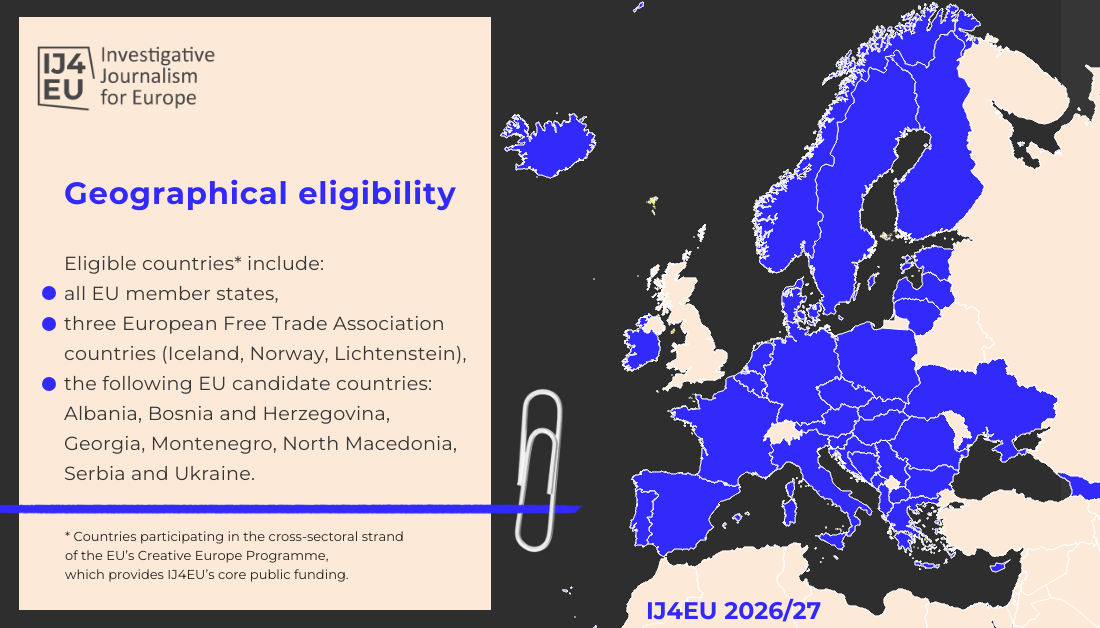
Under both schemes, applications must come from teams with journalists based in at least two European countries participating in the cross-sectoral strand of the EU’s Creative Europe Programme, which provides IJ4EU’s core public funding.
Eligible countries include all 27 EU member states, as well as Albania, Bosnia and Herzegovina, Georgia, Iceland, Liechtenstein, Montenegro, North Macedonia, Norway, Serbia and Ukraine.
More than funding
IJ4EU is about far more than grants. All supported teams gain access to a robust safety net designed for the realities of investigative reporting, including:
- Legal risk training and access to a contingency fund for unexpected legal costs;
- Training in digital security, coping with online harassment and mental well-being;
- Advocacy and emergency support through close integration with the EU-funded Media Freedom Rapid Response initiative;
- Mentoring, peer learning and knowledge-sharing to strengthen long-term resilience.
Flagship events from previous IJ4EU cycles will return in 2026 and 2027, bringing the community together to recognise outstanding cross-border investigations and to exchange ideas on the future of collaborative reporting in Europe.
Coordinated by the ECPMF, the IJ4EU Impact Award and the annual UNCOVERED Conference will once again take place each autumn, offering spaces for celebration, reflection and connection. Nominations for the 2026 Impact Award will open next month.
While continuing to address the core challenges of collaborative reporting, the UNCOVERED Conference will expand its focus to innovative investigative techniques and sustainable business models for watchdog journalism.
“As media landscapes grow more fragmented, it is cross-border investigative journalism that continues to unite journalists across Europe,” Deniz Bozkurt, IJ4EU project and event manager at ECPMF, said.
“We at ECPMF are thrilled to support and celebrate these collaborations through the IJ4EU Impact Award and UNCOVERED Conferences for another two years.”
Grantees will also receive secure collaboration tools and practical support from Arena for Journalism in Europe, including masterclasses in cross-border journalism, help identifying collaboration partners and leadership training for coordinating international projects.
Proven impact
Since 2018, IJ4EU has supported hundreds of journalists in every EU member state and beyond. Funded investigations have reached millions of readers, prompted parliamentary scrutiny, shaped policy debates and exposed systemic wrongdoing.
By combining funding with legal protection, skills development and cross-border solidarity, IJ4EU aims to ensure that investigative journalism continues to serve European societies — even in hostile or high-risk environments.
The latest edition of IJ4EU will put a greater emphasis on peer-to-peer learning, with the IJ4EU website serving as a repository of knowledge available to anyone interested in the intricacies of cross-border watchdog journalism.
Journalists and news organisations are encouraged to sign up for the IJ4EU newsletter for updates, guidance and application tips.
Press contacts
- IPI: Timothy Large, director of independent media programmes, tlarge[at]ipi.media
- EJC: Zlatina Siderova, programme lead grants, siderova[at]ejc.net
- ECPMF: Deniz Bozkurt, IJ4EU project and event manager, deniz.bozkurt[at]ecpmf.eu