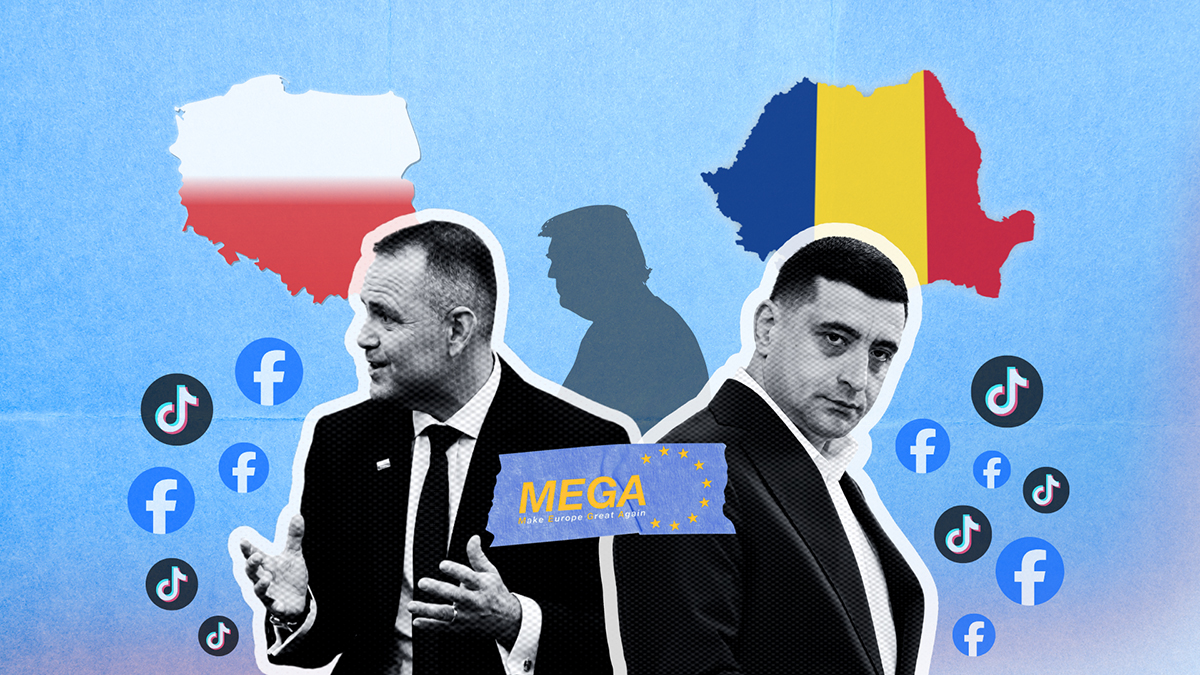


The Extremist Machine is a cross-border investigation into the hidden networks that connect illiberal and far-right political actors across Central and Eastern Europe — and how these networks operate behind elections, online influence campaigns and public discourse.
The project focuses on Romania and Poland, revealing how political operatives, communication strategists and affiliated organisations work across borders to support conservative and extremist causes. Through data analysis, open-source intelligence techniques and collaborative reporting, the investigation shows that national election campaigns are increasingly shaped by transnational alliances, shared digital infrastructures and coordinated messaging strategies.
One of the key stories uncovered how Romanian political consultants and influence networks quietly supported conservative political forces in Poland during election campaigns. What appears publicly as domestic political competition is, in fact, reinforced by cross-border cooperation, outsourced political communication and shared narratives that travel easily across borders — especially online.
The investigation exposes how these networks blur the boundaries between political campaigning, PR services, activism and disinformation, raising serious questions about transparency, accountability and democratic integrity in the region.
Main findings
The team…
- Exposed cross-border political cooperation between Romanian and Polish actors involved in conservative and illiberal election campaigns.
- Identified shared communication strategies used to influence voters, including coordinated messaging, digital amplification and narrative framing across national contexts.
- Revealed the role of political consultants and communication companies operating transnationally, supporting campaigns in multiple countries using similar tools and methods.
- Showed how social media platforms such as TikTok, Telegram, Facebook and X are central to spreading ultra-conservative and anti-EU narratives, often through coordinated or artificially amplified activity.
- Documented organisational and financial overlaps between political actors, NGOs and business entities that publicly claim civic or advocacy roles while serving partisan political goals.
- Demonstrated that these influence networks function as a regional ecosystem, not isolated national cases — adapting narratives to local audiences while relying on the same structures and actors.
Team
FRONTSTORY.pl: Daniel Flis, Anna Gielewska, Maciej Możański, Alicja Pawłowska, Anastasiia Morozova
Context.ro: Mihaela Tanase, Attila Biro, Oana Manitiu
Cooperation: Tamara Kanuchova (VSQUARE)