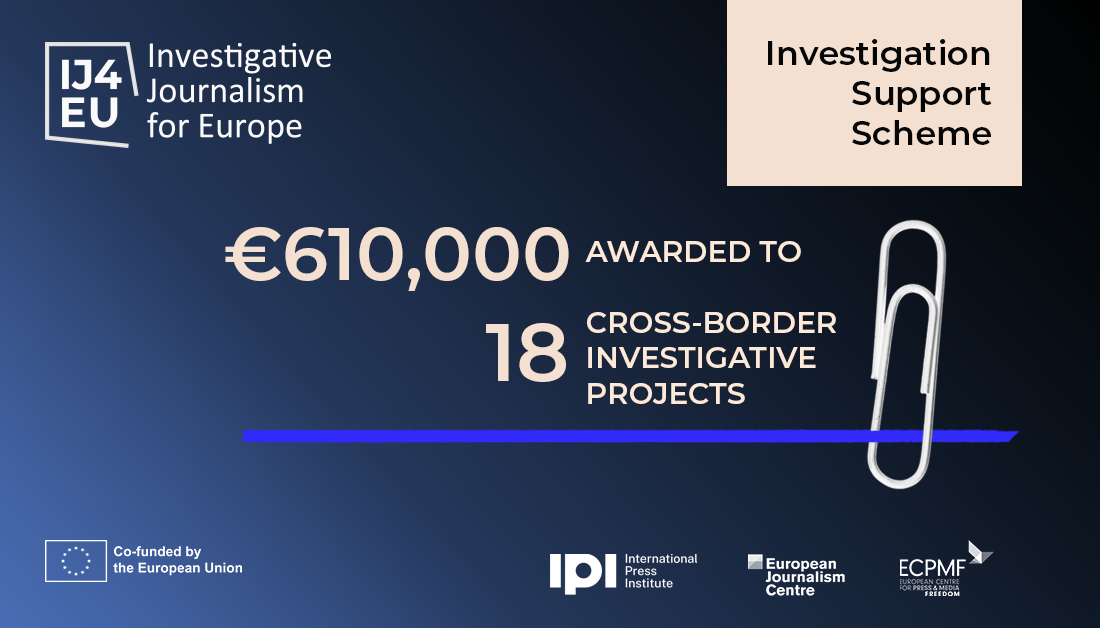


IJ4EU’s flagship support scheme awards 18 ambitious cross-border projects in the latest funding round.
Investigations into alleged war crimes, deadly gangs, Europe’s environmental footprint abroad, and Big Tech lobbying in Brussels are among the projects selected for support under the latest round of grants from the Investigative Journalism for Europe (IJ4EU) fund.
An independent jury awarded a combined €610,000 to 18 reporting teams working across 34 countries, as demand for funding for cross-border investigative journalism hits record levels.
The funding comes from IJ4EU’s flagship Investigation Support Scheme, which provides grants of up to €50,000, along with access to legal support, training, and networking opportunities.
Selected from a competitive pool of 149 applications, the awarded projects tackle subjects ranging from substandard pharmaceuticals and Europe’s carbon trading market to the transnational surrogacy industry and Russian armaments in Belarus.
“It was an inspiring exercise to review such a wealth of proposals in the company of wonderful jurors,” said María Teresa Ronderos, an award-winning Colombian journalist who chaired the five-person jury.
“The investigations were incredibly powerful and diverse. We had quite a challenge to choose only 18.”
Complex public-interest stories
Specific details of the investigations are confidential for now to avoid compromising upcoming reporting, but the range of topics and partnerships underscores the critical role of cross-border collaboration in tackling complex public-interest stories.
Here are vague descriptions of the selected projects, in no particular order:
- A data-driven, cross-border investigation on substandard pharmaceuticals – grant awarded: €44,800
- A cross-border investigation by Investigate Europe and partners into the environmental footprint of Europe’s rapidly expanding data centre infrastructure, focusing on local impacts and hidden costs that have so far received little public scrutiny – €46,400
- A cross-border investigation into the European banking sector, its flaws, shortcomings, and potential sanctions breaches – €50,000
- Lost in Europe will reveal how EU fishing policies and regulatory failures drive deadly migration from West Africa to Europe – €34,200
- A cross-border investigation into alleged war crimes and whether any legal accountability mechanisms are being pursued – €50,000
- A cross-border investigation drawing on a massive dataset leak concerning European-supported activities in Africa, especially in the Democratic Republic of Congo – €27,000
- A cross-border investigation into how Europe’s gas diversification fuels environmental and social harm in the Global South – €34,700
- A cross-border investigation into how influential misogynist networks use international corporate structures to finance and expand their reach – €18,205
- Investigative reporters in six countries will look into how Big Tech in Brussels undermines European legislation and what this means for European businesses and digital sovereignty – €44,560
- A multi-platform investigation looking into human rights abuses in the migration system – €25,986
- A cross-border investigation into a Caribbean island that is one of the main drivers of the global offshore betting market – €21,550
- Vertical52, the Belarusian Investigative Center and Slidstvo.Info will use open-source intelligence techniques and satellite data to investigate Russian armaments in Belarus – €34,387.60
- A cross-border investigation into the transnational surrogacy industry – €21,600
- An investigation about how a French industrial group is expanding its role in the supply chains of critical minerals for the green transition, and the consequences for workers, communities, and ecosystems across several countries – €34,950
- A cross-border, data-driven investigation into how weaknesses in Europe’s carbon trading market may have been exploited through suspicious allowance trades, offshore financial flows, and interconnected corporate networks – €21,750
- A cross-border investigation into how a new criminal force within the EU is expanding its role from logistical broker to a full-blown mafia enterprise – €42,180
- A cross-border investigation into the delivery of dual-use chemicals and components to Russia by a global technology manufacturer – €7,822
- A cross-border investigation into who controls the flow of humanitarian aid in conflict – €50,000
Global footprint
The awarded teams include journalists based in 16 EU member states, two EU candidate countries and 16 additional countries: Argentina, Australia, Belarus, Colombia, the Democratic Republic of Congo, Indonesia, Jordan, Mozambique, Norway, Palestine, Senegal, South Africa, Switzerland, Turkey, the United Kingdom, and the United States.
The Investigation Support Scheme is managed by the Vienna-based International Press Institute, which also leads the consortium of media-support organisations that run the IJ4EU fund. The scheme is open to cross-border teams of any configuration, including newsrooms, investigative non-profits, and freelancers.
The Investigation Support Scheme runs in parallel to another funding track, the Freelancer Support Scheme, aimed at teams made up of journalists working outside of newsroom structures. Results from the latest round of that programme will be announced shortly.
In addition to financial support, teams selected under both schemes have access to legal assistance, training, a specialist IJ4EU conference, and practical support.
Across the 2026/27 funding cycle, the IJ4EU fund will allocate €1.6 million in grants. The next call for applications to both the Investigation Support Scheme and the Freelancer Support Scheme will open on December 1, 2026.
Funding for IJ4EU comes from the European Commission together with philanthropic supporters including Fritt Ord Foundation and Adessium Foundation, but strict safeguards ensure complete editorial independence.
Rather than fund investigations directly, donors support a system administered by a neutral consortium made up of IPI, the European Journalism Centre, and the European Centre for Press and Media Freedom.
The consortium operates at arm’s length from funders and oversees the programme’s implementation, while all grant decisions are made by external juries through an open and transparent selection process.
Applications to the latest IJ4EU calls came from teams based in 63 countries seeking €6.8 million in total support — an indication of both the financial strain facing investigative journalism and the growing appetite for collaborative reporting models.