Beyond publication: How watchdog journalism makes a difference
Published on: 01 October 2026
What do the 2026 IJ4EU Impact Awards reveal about the ambitions, pressures and responsibilities of investigative journalism in Europe?
A doctor sanctioned in one country resumes practising in another. A chemical factory closes in Europe, only to reappear thousands of kilometres away. Industry lobbying shapes a regulatory debate with little public scrutiny. A photograph celebrated by journalism’s own institutions carries a false description of a murdered man for three decades.
The investigations recognised at IJ4EU’s 2026 Impact Awards exposed very different failures. Taken together, they offer a revealing picture of the work independent investigative journalism is being asked to do: follow problems beyond the boundaries of national oversight, test the claims of powerful interests and dig into uncomfortable truths.
They also raise a question that extends well beyond an awards ceremony. What should count as evidence that this work matters?
“Our discussions kept returning to one deceptively simple question,” said jury chair Leila Bičakčić, co-founder and executive director of the Center for Investigative Reporting in Sarajevo. “What do we mean when we say that journalism has impact?”
Looking beyond audience figures
For Bičakčić, some answers were straightforward: a law changes, a regulator acts, a company changes its practices. But the jury’s deliberations also recognised consequences that are harder to count.
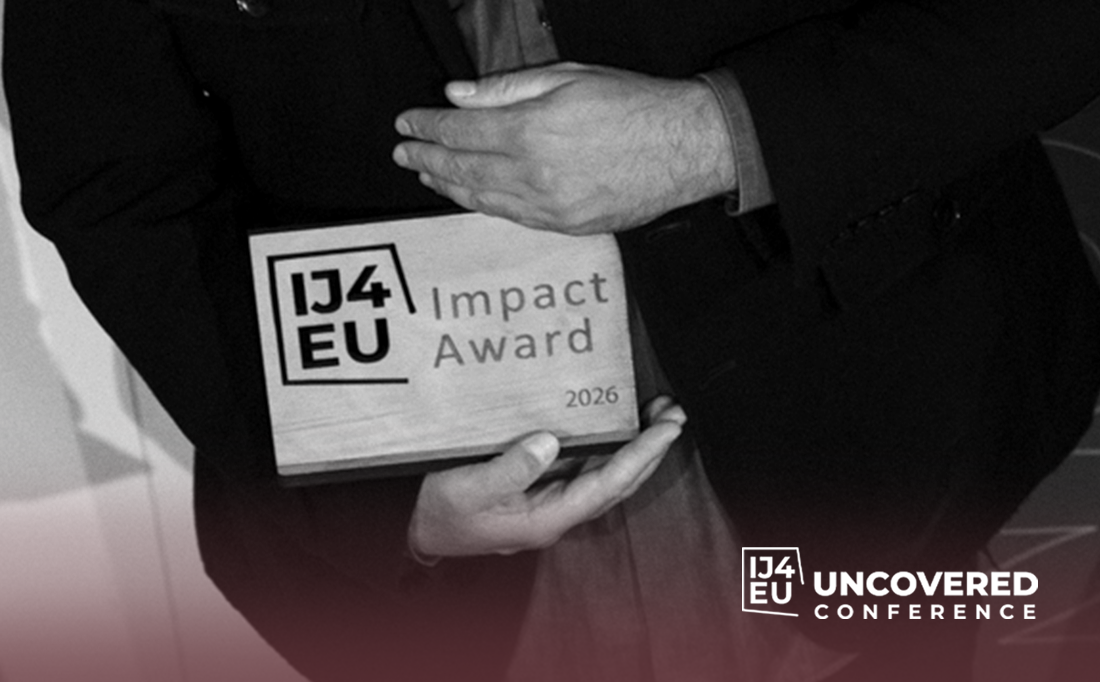
“Sometimes journalism exposes a failure that institutions can no longer ignore,” she said in a speech at the IJ4EU Impact Awards ceremony held during IJ4EU’s recent UNCOVERED Conference in Budapest.
“Sometimes it gives citizens evidence they did not previously have. And sometimes its impact lies in creating a public record — in making it impossible, later, for those in power to say: we did not know.”
That’s a useful distinction for a sector under pressure to prove its commercial worth. An investigation may produce evidence that others use long after publication. Its contribution can be substantial even when change is slow. Yet recognising that wider value requires care in attributing results to the journalism itself.
“We also tried not to confuse reach with impact,” Bičakčić said. “Millions of views are impressive, but visibility alone does not necessarily change anything.”
The jury asked what happened next: who reacted, who used the evidence, whether institutions acted and whether other journalists built upon the reporting. Crucially, she added, “could we establish a meaningful connection between the journalism and what followed?”
That question encourages a more demanding account of impact than either audience figures or a list of developments that happened after publication. It asks journalists to document consequences with the same attention they bring to documenting the original problem — a luxury many hard-pressed newsrooms and freelancers simply don’t have.
When oversight stops at the border
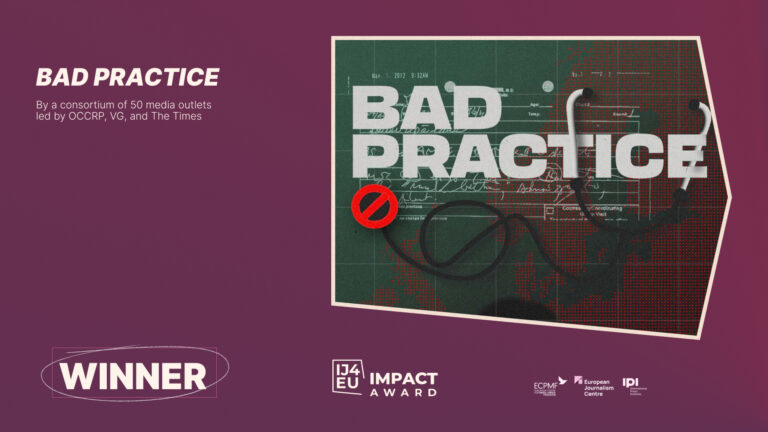
Bad Practice, one of three equal winners, examined how doctors stripped of their licences in one country could continue working elsewhere. Reporters from 50 media outlets working across 44 countries investigated the gaps that left patients exposed.
Oleg Khomenok, senior programme manager at Internews Network, described the investigation’s starting point as “a fundamental human element: trust”. Patients assume that the systems overseeing medical practice will protect them. The reporting examined what happens when that assumption fails.
“Imagine a system where individuals banned for major wrongdoing can easily jump borders, relocate to another country, and quietly pick up their careers as if nothing happened,” Khomenok said in written remarks. “The public, at the same time, remains entirely unaware.”
The investigation’s coordinated national stories made a shared failure visible to audiences in different countries. Its form reflected the problem it was investigating: understanding the system required looking beyond any single jurisdiction.
Bičakčić expressed the wider principle plainly: “The stories themselves cross borders because the problems they investigate cross borders.”
She added; “Accountability therefore has to cross borders as well. And journalism must be able to do the same.”
Following the harm rather than the apparent ending
Two winning investigations concerned PFAS, dangerous pollutants known as “forever chemicals”. Their recognition points to the importance of examining both the movement of hazardous production and the political efforts to resist its regulation.
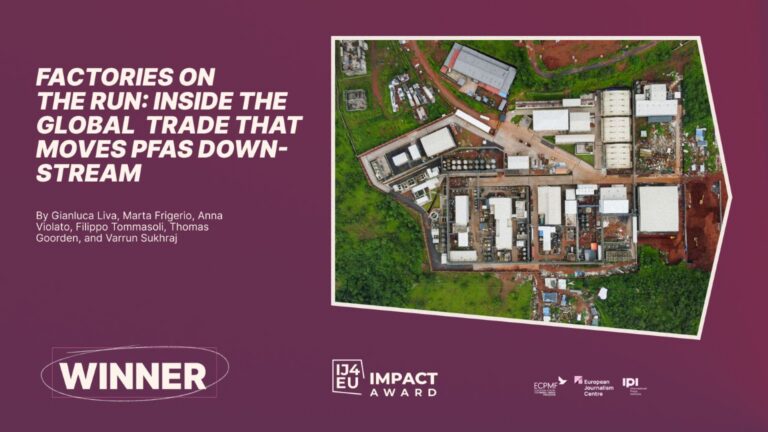
Factories on the Run followed a factory from Italy to India after its closure and dismantling. The team discovered that an apparent ending in Europe was the beginning of another story elsewhere.
“For many, that was where the story ended,” said jury member Neus Vidal, executive director of the Seek Initiative. “But the team we are honouring tonight investigated further. They discovered that the factory had not disappeared. It had been taken apart, shipped overseas and rebuilt in India, where it went back to work with the same chemicals.”
The investigation challenges the geographical limits of how success is understood. Ending a harmful activity in one place does not necessarily end the harm. Following its relocation requires journalists to ask whose experience remains outside the original account.
Vidal also emphasised who had done the work: a small group of freelance journalists.
“Above all, their work made a real difference in the place where that harm was happening,” she said. “That kind of impact is hard to achieve even for large, well-resourced newsrooms.”
Alongside the much larger collaborations honoured at the ceremony, this offers a reminder that investigative capacity cannot be judged by newsroom size alone. Small teams can pursue consequential stories across continents. Their achievement strengthens the case for support that allows freelancers to sustain such work.
Testing the arguments of power
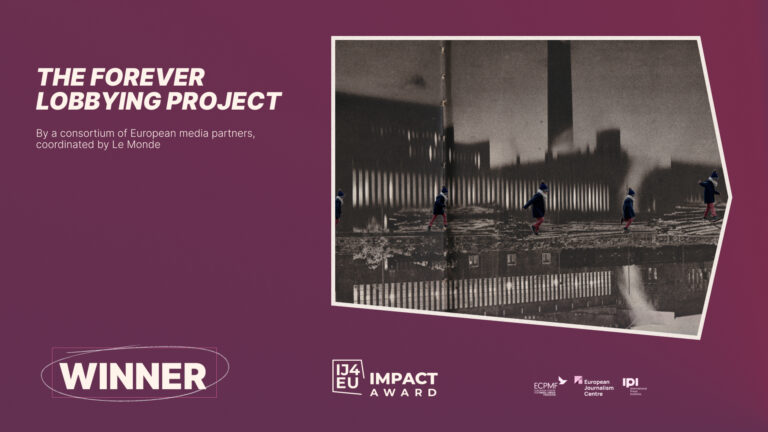
The Forever Lobbying Project examined efforts to weaken and delay European restrictions on PFAS. Its collaboration brought together 46 journalists and 18 experts, involving 29 media partners across 16 countries.
For jury member Maryna Rakhlei, a senior programme officer at the German Marshall Fund of the United States, its importance lay partly in how it examined the arguments being used to influence policy.
“The journalists did not stop at exposing the lobbying,” she said. “They asked whether the arguments being used to influence European policy were actually true and built a rigorous way of testing them with scientists and other experts.”
This is a particularly demanding public-interest role. Revealing who is seeking influence is one task; assessing the evidence behind their claims is another. Collaboration with scientific experts gave the reporters a way to scrutinise arguments whose technical complexity might otherwise shield them from public examination.
“It gives the public the evidence to judge whose interests are shaping decisions that affect all of us, our health, our environment and our daily lives,” Rakhlei said.
Her speech also described the pressure, threats and intimidation encountered by the investigation. The ambition celebrated by the awards therefore comes with a practical question for those supporting journalism: how to sustain the time, expertise and protection that work of this complexity requires.
Applying scrutiny to journalism itself
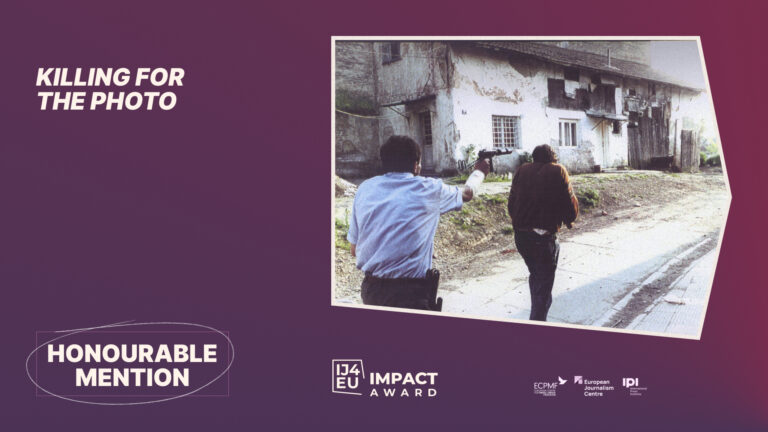
The jury’s special recognition for Killing for the Photo brought the discussion of accountability closer to home.
The investigation by Barbara Matejčić in collaboration with Natalija Jovanović and Ruben Brugnera revisited award-winning photographs of a Bosnian Serb paramilitary executing a civilian in 1992. It examined the possible role of the photojournalists’ presence and led to the correction of a caption that had wrongly identified the victim as an armed sniper for 30 years.
“It forces journalism to confront its own possible failures,” said jury member Can Ertuna, a journalist and associate professor at Bahçeşehir University in Istanbul. Those questions, he added, “remain painfully relevant as journalists document the wars in Ukraine and Gaza today”.
The significance lies both in the correction and in the willingness to question a celebrated journalistic account. Independence requires scrutiny of the profession’s own institutions, reputations and assumptions.
“It demonstrates that journalism does not have to accept the historical record as fixed,” Ertuna said. “By returning to the evidence, questioning established narratives, and correcting past wrongs, journalism can contribute to justice and perhaps offer some measure of healing to victims and their families.”
His qualification matters: journalism can contribute to justice; it cannot promise it. But the passage of time does not remove the obligation to seek accuracy or the value of correcting the record.
Even so, the jury’s reflections illuminate some of the demands facing the sector: investigations spanning jurisdictions, technical claims requiring specialist expertise, and reporting whose consequences need to be followed long after publication.
Bičakčić placed these achievements against “financial pressure, political pressure, legal threats and declining trust”. In those circumstances, she said, collaboration “is increasingly essential”.
For organisations supporting independent journalism, these awards make a case for investing in the conditions that allow such collaboration to endure. That includes giving small teams the opportunity to pursue ambitious stories and recognising that building a public record can have lasting value even before an institution acts.
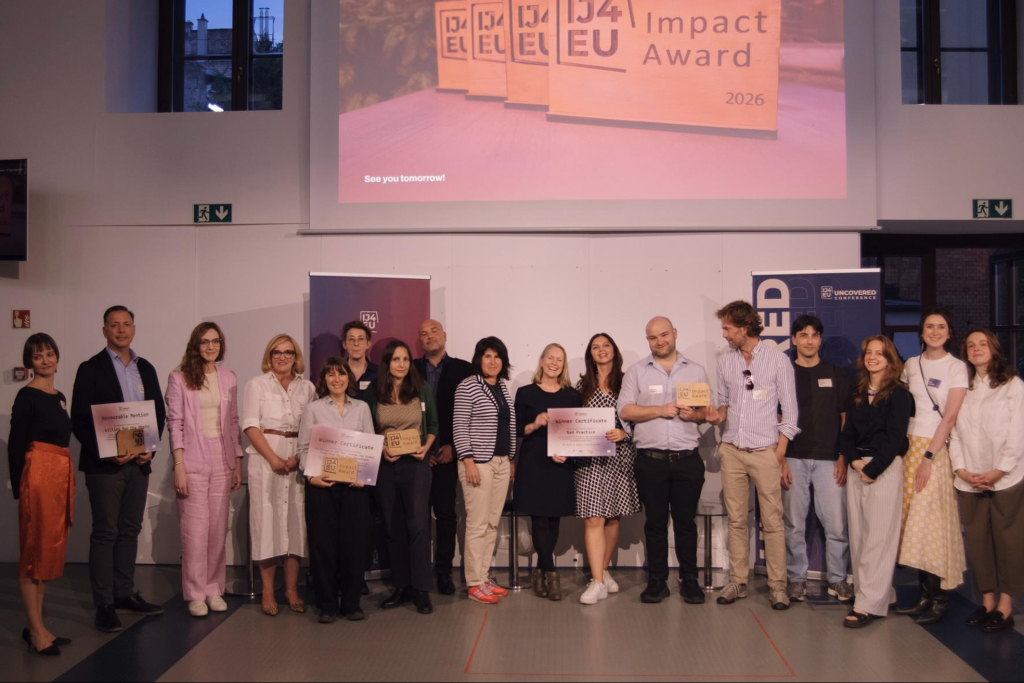
Photo by Lisa-Marie Bosbach/ECPMF
The jury’s speeches celebrated persistence while setting a demanding standard: follow the evidence across borders, examine what follows publication, and apply the same scrutiny to journalism’s own record.
As Bičakčić told the journalists: “Thank you for reminding us that investigative journalism does not end when a story is published. Sometimes that is precisely where its impact begins.”
We use cookies to ensure that we give you the best experience on our website. If you continue to use this site we will assume that you are happy with it.